
A fully working robotic hand that can gently grasp fruit, wrap around cups, and adapt its grip like a human hand usually comes out of a well-funded robotics lab. This one came out of a teenager’s Lego collection.
In the UK, 16-year-old Jared Lepora has built an anthropomorphic robotic hand entirely from LEGO MINDSTORMS parts. It looks playful at first glance, but beneath the plastic beams and gears is a design rooted in serious robotics research.
The project, called Educational SoftHand-A, was developed over nearly two years with guidance from Jared’s father, Nathan Lepora, a robotics professor at the University of Bristol. Instead of relying on 3D-printed parts or custom metal components, the pair translated advanced ideas from soft robotics into something that could be built with off-the-shelf Lego.
Jared said the idea grew naturally from watching his father’s work. “My dad specialises in making advanced robot hands, and I thought these principles were always really cool, so why not make it out of Lego?” he said.
Also Read: Humanoid Robot Kicks Its Trainer in the Groin
The hand is built around a concept called soft synergies. Human fingers rarely move in isolation but tend to move together in coordinated patterns, especially when grasping objects. Modern robotic hands often copy this idea to reduce complexity, using a single tendon system to spread motion across multiple fingers instead of controlling each joint independently.
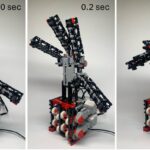
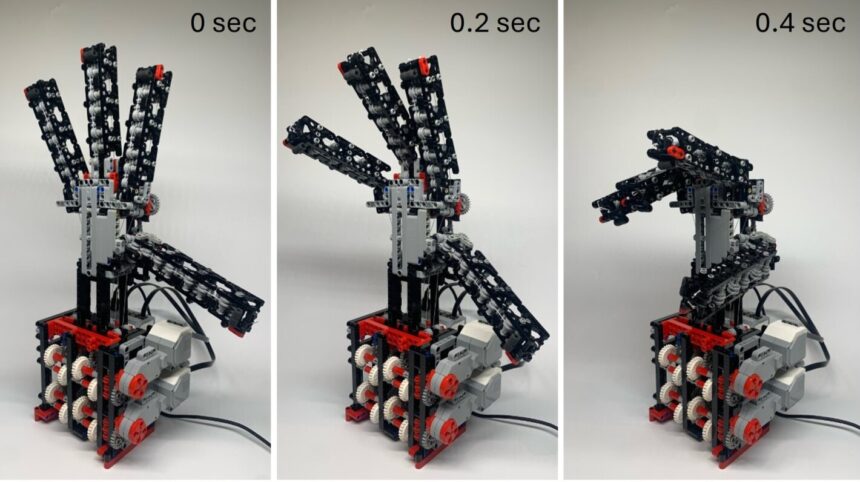
The Lego hand follows the same mechanism, with four fingers each having three joints, but it is driven by just two small motors. When it has to grip an object, tendons pull the fingers closed while Lego clutch gears spread the motion across the hand. As soon as the fingers make contact, the movement naturally slows and stops, letting the hand adjust its grip on its own without sensors or complex programming.
Despite being built from toy components, the performance is impressive. Tests reported the hand can achieve about 90% of the grip force of a professional SoftHand made using 3D printing. It can also open and close in about one second.
The design is based on the Pisa/IIT SoftHand, a well-known soft robotics model used in research labs worldwide. What makes the Lego version stand out is its accessibility. The entire system can be assembled using household tools, and all build instructions and files have been released openly so that schools and students can replicate or modify it.
Nathan Lepora said the value of the project goes beyond performance. “If anyone can build the hand, and maybe other children can make design changes, then that’s really exciting,” he said.
The hand is meant as an educational bridge. By physically building tendons, joints, and compliant mechanisms, students can directly see how robotic grasping works, rather than treating it as abstract theory.
Also Read: AgiBot Q1: The Humanoid Robot That Can Easily Fit in Your Backpack
After finishing the project and co-authoring the academic paper, Jared was invited to present the work at the IEEE Intelligent Robots and Systems conference in 2025 in China, becoming the youngest speaker at the event.
The project shows how complex ideas in robotics can be made approachable, using simple materials to turn research concepts into something students can build and learn from.
The paper is published on arXiv.