


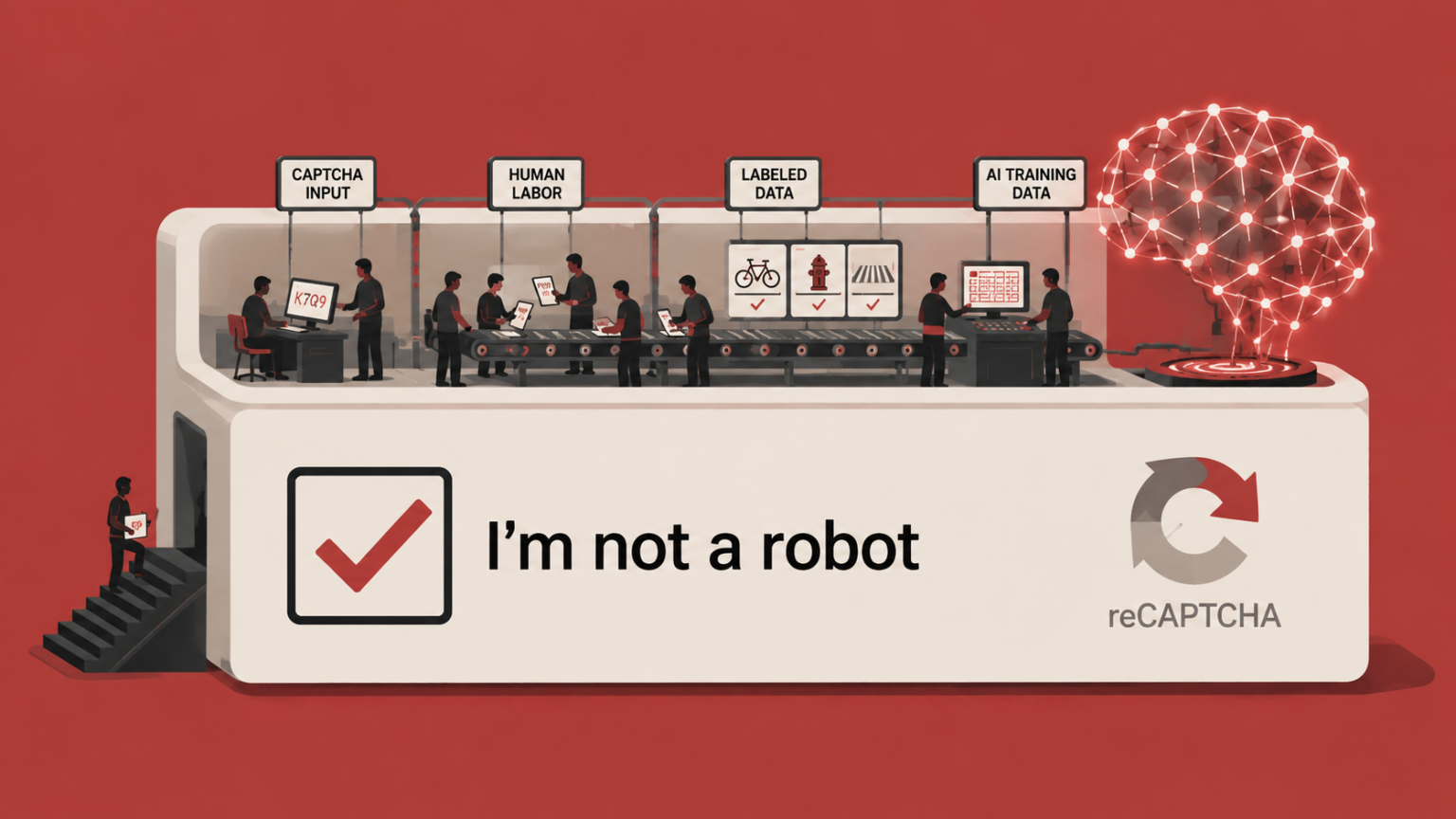
You’ve typed those squiggly letters a thousand times. You’ve clicked “all squares with traffic lights” and still weren’t sure if that sliver in the corner counted. You did it to shop on Amazon, log into an account, or recover a password you forgot. You never got paid for it. And for close to two decades, that ten-second annoyance has quietly been one of the largest unpaid labor forces on the internet.
"wait, that's real?"
The story begins with a Guatemalan computer scientist named Luis von Ahn, who pioneered CAPTCHAs with Manuel Blum in 2000. The idea was to build automated tests that humans could pass easily but bots could not. Websites needed a simple way to block bots from mass-registering accounts or posting spam, and it turned out the human brain was still far better than machines at reading distorted text.
But von Ahn didn’t stop at security. He kept thinking about the sheer amount of human time these tests were consuming for nothing in return. For scale, we spend roughly 500 years a day just solving CAPTCHAs. Years, not hours.
Also Read: AI Agent Beats Human Hackers in Stanford Cybersecurity Experiment
That thought turned into reCAPTCHA. Von Ahn realized that all those wasted seconds could be redirected toward something useful, so in 2007 he built a system where every test actually showed two distorted words. One verified you were human, and the other came straight from old books and newspapers being digitized, words that optical character recognition software had failed to read. By showing the same words to multiple people, the system could also verify that the text was transcribed correctly.
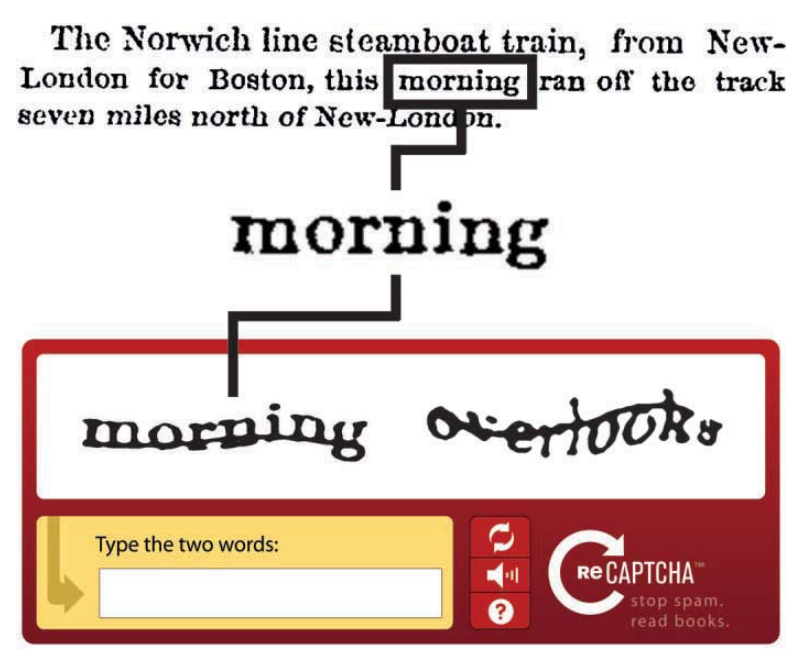
Google acquired reCAPTCHA in 2009, and within a few years it had helped digitize the entire Google Books archive and more than 13 million New York Times articles dating back to 1851. The millions of people solving those CAPTCHAs never got a paycheck. Nobody signed a labor contract. You just wanted to fill out a form, and somewhere, a blurry word from a 1920s newspaper got read correctly because of it.
Then Google ran out of books. In 2012, Google started including snippets of photos from Google Street View, making users transcribe house numbers and street signs, and by 2014 the system had largely shifted toward training AI.
Now, for example, to teach an AI what a dog looks like, it needs to see a huge number of pictures someone has already labeled as dogs. Then it starts recognizing the patterns that distinguish a dog from everything else, and the more examples you feed it, the more accurate it becomes at identifying a dog.
So when you click the boxes containing a crosswalk or a bicycle, you’re doing the same kind of work a paid data labeler does elsewhere in the AI supply chain. The only difference is you’re doing it for free, sandwiched between proving you’re not a robot and signing in to the website you wanted.
Also Read: A Man Convinced an AI Chatbot to Sell Him a $76,000 SUV for $1
And the cost of all that “free” work is not small. A large-scale study covering thirteen months of reCAPTCHA use found the system offers only modest protection against bots and functions largely as a tool for tracking user behavior and collecting data. It estimated that in 13 years of its deployment, the collective human time spent on reCAPTCHAs was 819 million hours, worth an estimated $6.1 billion in wages.
Put another way, humanity has spent the equivalent of nearly a hundred thousand years clicking on fire hydrants and crosswalks so machine learning models could get sharper.
"wait, that's real?"
Still, reCAPTCHA is a great example of what a few wasted seconds, if used smartly, can add up to at scale. Ten seconds proving you’re human is nothing on its own, barely a blip in your day. Multiply that by billions, though, and you get hundreds of millions of hours, an entire reserve of human brainpower that would have disappeared for nothing.
Von Ahn’s real insight was spotting that reserve and redirecting it into something productive, the same instinct he later carried into Duolingo, but that’s a story for another day.
So the next time a CAPTCHA asks you to prove you’re human, remember you’re not just passing a test. You’re an unpaid worker who, in the process of proving you’re not a robot, may be helping build one.
And if you made it here, you’re the kind of person who’d like what we send on Sundays — stories like this, every week, straight to your inbox. Join our newsletter.
Story Sources: reCAPTCHA – Wikipedia, TechRadar, Luis von Ahn – Wikipedia, BoingBoing, AP News, Binance, Stack Exchange, Cloudflare Blog, Webflow