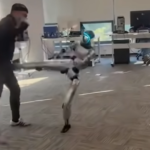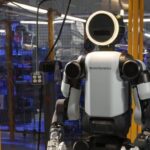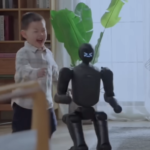

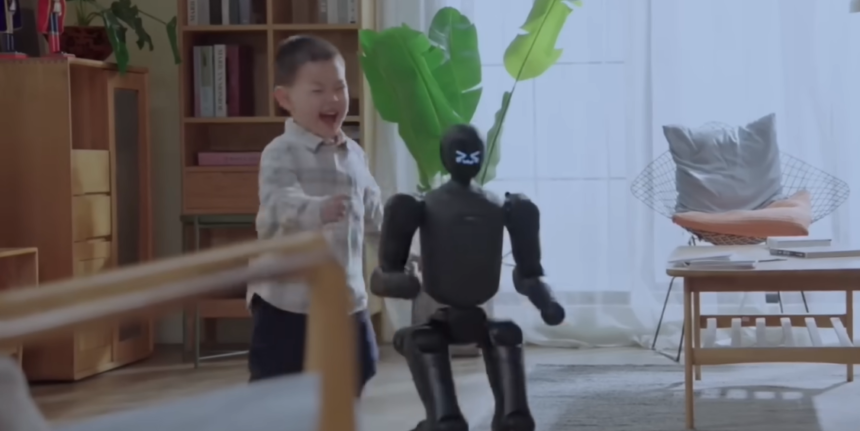
The traditional development of humanoid robots has long been an exercise in industrial scale, but China’s AgiBot is fundamentally challenging this model by proving that smaller, personal systems can actually solve the biggest hurdles in robotic science. At CES 2026, the Shanghai-based firm debuted its consumer-focused brand PrimeBot, introducing the Prime Q1 and Prime T1—two robots that signal a decisive shift from factory-bound machines to domestic, personal companions.
The Q1, described as the “world’s smallest” full-body force-controlled humanoid robot, stands just 80 centimeters tall while carrying the technical capabilities of its larger industrial predecessors. For researchers, its compact size is a tactical response to the “sim-to-real” gap, the notorious difficulty of training robots that work in a computer simulation correctly in the physical world.
In the past, testing advanced walking or balancing algorithms on a full-sized humanoid was a high-risk gamble; a single mistake could result in a catastrophic fall, destroying months of work and thousands of dollars in hardware.
Also Read: World’s Smallest Autonomous Robot That Can Sense, Think, and Act
Because the Q1 is roughly one-eighth the mass of a standard adult-sized humanoid, it is inherently crash-resistant. Its miniaturized Quasi-Direct Drive (QDD) joints, which are roughly the size of an egg, allow it to fail safely. Researchers and hobbyists can now test aggressive movements and fluid dynamics in the real world, knowing that a faceplant is a minor learning event rather than a total hardware loss.
While the Q1 focuses on this bipedal humanoid form, its sibling, the Prime T1, explores a different kind of personal utility through a transformable design. The T1 is built to handle the varied terrain of a real home, shifting between a wheeled humanoid configuration for indoor navigation and a bionic quadruped mode for outdoor environments. This dual-form mobility allows it to climb stairs and handle steep inclines that would stop a traditional wheeled robot.
Both the Q1 and T1 are built on an open-source platform that invites the user to be a co-creator rather than just a consumer. AgiBot has provided the Hardware and Software Development Kits (HDK/SDK) along with 3D-printing options for exterior shells, meaning a user can customize their robot’s appearance to be anything from a stylized companion to a specialized laboratory tool.
The core of these robots is the Agi-Soul AI platform, which provides more than just pre-programmed responses. It enables multimodal interaction by combining voice recognition, gesture sensing, and long-term memory, allowing the robot to learn from previous interactions and create a more context-aware personalized experience—what the developers call an “understanding you” experience.
Instead of requiring complex coding, the system uses a zero-code motion platform that lets users assemble behaviors like building blocks. This makes the technology accessible to students and artists who want to explore embodied AI without a background in robotics engineering.
Also Read: Paralysed Man Controls Robots With China’s Brain-Computer Interface Technology
This move by AgiBot suggests that the future of humanoid intelligence may not be found in massive labor-replacement machines, but in portable, resilient tools that people can carry, customize, and live with on a personal scale. Whether serving as a dance coach, an English tutor, or a cinematic camera crew on wheels, these robots are designed to fit seamlessly into everyday environments—on desks, in classrooms, or alongside creative studios—where they can be directly engaged, programmed, and adapted by individuals.
By shrinking the hardware while maintaining full-body force control, AgiBot has transformed the humanoid from a distant corporate promise into a tangible personal device. As these compact systems move out of specialized labs and into classrooms and studios, they are turning robotic development into a creative process that is open to everyone.