


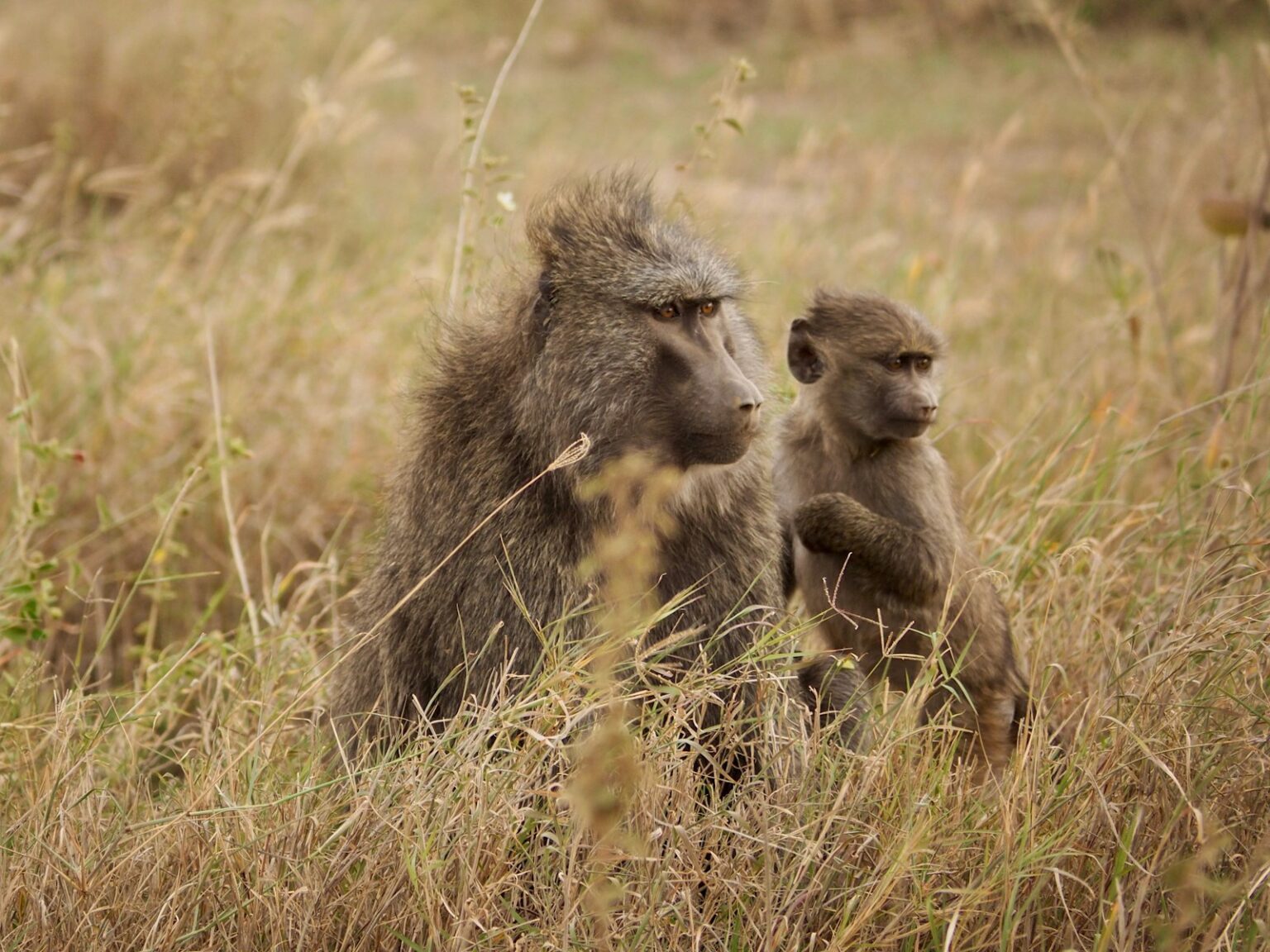
When we talk about differences between males and females in animals, size often gets most of the attention. Males are usually bigger, females smaller, and that’s where the conversation stops.
But a new study in Frontiers in Ecology and Evolution takes a closer look at skulls of baboons (Papio) and geladas (Theropithecus) and finds that size is only part of the story. Shape matters too, and it evolves under more than one influence.
The research team examined 570 skulls from museum collections. They placed 30 three-dimensional landmarks on each specimen, giving them a way to compare shapes with precision. This method, called geometric morphometrics, lets scientists see how shape changes with size, and whether there are differences between males and females beyond the obvious size gap.
Similar: Brain Imaging Reveals Gender-Based Differences in Acupuncture Response
As expected, they found that larger size in males explained a lot of the shape differences. The first axis of variation in their analysis was strongly linked with size.
But when they adjusted for that, they still saw consistent differences between the sexes. In other words, males and females are not only different because one is larger. They also have differences in cranial proportions that are independent of size.
When plotted on graphs, males and females of each species formed clear clusters. The two genera, baboons and geladas, also separated from each other in ways that size alone could not explain.
Geladas, for example, stood out with a distinctive cranial profile, even though their overall size sometimes overlaps with that of smaller baboon species.
The study also compared how much sexual dimorphism exists across species. Some baboon species, like Papio ursinus and Papio anubis, showed large differences between male and female skulls. Others, like Papio kindae, showed smaller gaps. Geladas had dimorphism levels closer to the smaller baboons than to the more strongly dimorphic ones.
Similar: Longer Thumbs Are Linked to Bigger Brains in Humans and Primates
One of the most interesting points is that social and ecological conditions don’t fully account for these patterns. We often assume that stronger male competition leads to bigger differences between sexes, but that explanation only works up to a point.
The authors note that evolutionary history, what they call phylogenetic imprint, plays a major role. In other words, today’s differences are partly shaped by long-term evolutionary constraints, not just by current environments or social systems.
The findings add to our understanding of how primate skulls evolve. They show that sexual dimorphism is not a simple matter of one sex being larger than the other. Shape evolves alongside size, and the two interact in complex ways.
The study also highlights the importance of looking across multiple species, since comparing only one pair of sexes could give an incomplete picture.
Of course, the research has limits. Some species had smaller sample sizes, especially for females, which may reduce the strength of certain comparisons.
While the study focused only on skull morphology, future research including genetic or ecological data could provide a more complete understanding of why these differences exist. Even so, the study gives a detailed view of how size and shape interact in these primates, showing that sexual dimorphism is influenced not just by overall size, but also by evolutionary history, which can impose phylogenetic constraints on how skull shapes evolve.
So, next time we talk about male and female differences in animals, it might be worth remembering that it’s not only about “bigger or smaller.” Skulls, and the evolutionary forces behind them, are telling a more layered story.
Story Source: Ossorio et al. (2025), published in Frontiers in Ecology and Evolution. Read the original study here.