

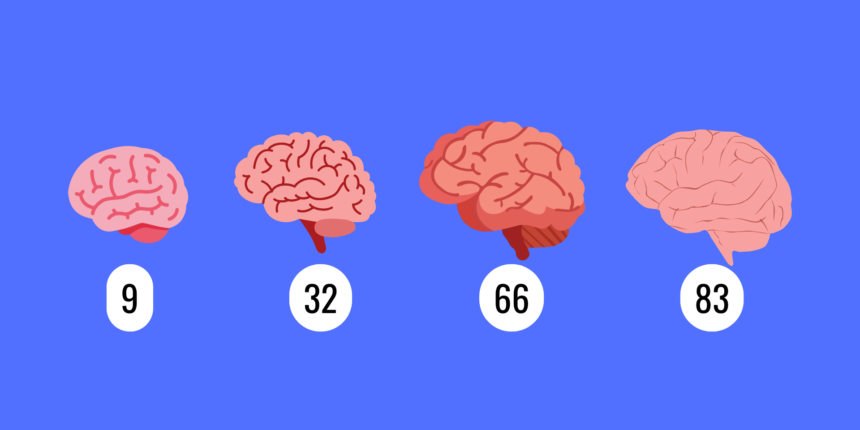
Scientists have long known that the human brain keeps changing from birth to old age, but a new study maps that journey in much greater detail. Neuroscientists at the University of Cambridge have identified five “major epochs” of brain structure, each separated by a turning point where the brain’s wiring reorganises in a noticeable way.
The work, published in Nature Communications, analysed MRI diffusion scans from 3,802 people aged from 0 to 90. These scans trace the movement of water molecules through brain tissue, allowing scientists to reconstruct the architecture of neural pathways. By comparing thousands of these brain maps, the team detected patterns that reveal how the brain’s wiring shifts across life.
“We know the brain’s wiring is crucial to our development, but we lack a big picture of how it changes across our lives and why,” said Dr Alexa Mousley, the study’s lead author. “This is the first work to identify major phases of brain wiring across a human lifespan.”
Also Read: Men and Women Age Differently, Says New Research
The first era runs from birth to around age 9. This stage is defined by “network consolidation”, when the brain sorts through the huge set of synapses — the connectors between neurons — that it overproduced in the baby’s brain. Many of these early connections are whittled down, while the more active ones survive, gradually shaping the brain’s early architecture.
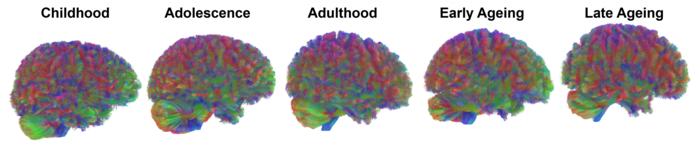
Meanwhile, grey and white matter expand rapidly, so the cortical thickness — the width of the grey matter layer above the white matter — reaches a peak, and cortical folding, the brain’s characteristic surface patterns, stabilises.
At the first turning point, at age nine, the brain experiences a change in cognitive capacity, as well as an increased risk of mental health disorders.
From 9 to about 32, the brain undergoes an extended adolescence-like phase. White matter continues maturing, and communication between regions grows more efficient. Information begins travelling along shorter, more streamlined routes. “Around the age of 32, we see the most directional changes in wiring and the largest overall shift in trajectory,” Mousley said. This makes the early thirties the “strongest topological turning point” across the entire lifespan.
Adulthood then extends from the early thirties to roughly age 66. Compared to the rapid changes earlier, the brain’s architecture stabilises. The researchers note increasing “segregation” during this era, as different regions become more specialised and compartmentalised. This long stretch lines up with research showing that intelligence and personality traits tend to plateau during midlife.
A gentler transition appears around 66, marking the start of early aging. It is not defined by a sudden structural shift, but patterns across the scans indicate a cumulative reorganisation. White matter starts to degenerate and whole-brain connectivity gradually decreases. “The data suggest that a gradual reorganisation of brain networks culminates in the mid-sixties,” Mousley explained. This also overlaps with higher risks of health conditions that affect the brain.
Also Read: Meditation Depth Can Be Seen in the Brain, Study Shows
The final turning point appears around age 83. Here, global coordination continues to diminish, and the brain increasingly depends on certain regional hubs. While data for this phase is more limited, the trend points toward a shift from broad communication to more local processing.
Senior author Prof Duncan Astle noted the research highlights how the brain’s wiring underlies many developmental and cognitive conditions. “Differences in brain wiring predict difficulties with attention, language, memory, and a whole host of behaviours,” he said.
Recognising that the brain’s structural journey consists of a few major rearrangements, rather than a smooth, continuous shift, could help researchers pinpoint moments when the brain is most vulnerable—or most open to support.
The study’s timeline suggests that just as our lives move through stages, our brains follow a few major turning points, each shaping how we think, learn, and age.
The study was published in Nature Communications.