

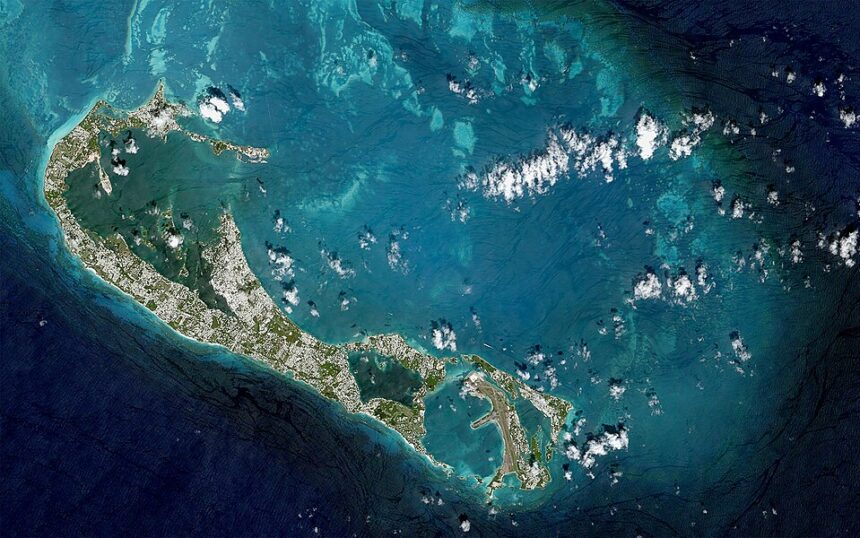
For centuries, Bermuda’s name has carried a sense of mystery, mostly thanks to stories tied to the Bermuda Triangle. But now scientists say the real mystery surrounding Bermuda has nothing to do with vanishing ships or aircraft. Instead, it lies buried deep beneath the Atlantic Ocean.
Researchers have discovered a massive, unusual rock layer hidden beneath Bermuda — an archipelago consisting of 181 islands, sitting below the oceanic crust where it does not belong. The layer is about 12.4 miles thick, or roughly 20 kilometres, making it far thicker than similar structures seen anywhere else on Earth.
“Typically, you have the bottom of the oceanic crust, and then it would be expected to be the mantle,” Live Science quoted the study’s lead author, William Frazer, as saying. “But in Bermuda, there is this other layer that is emplaced beneath the crust, within the tectonic plate that Bermuda sits on.”
Also Read: Physicists Prove the Universe Is Not a Computer Simulation
The discovery, published in the journal Geophysical Research Letters, could help solve a long-standing geological puzzle. Bermuda sits atop an oceanic swell, a broad region of elevated seafloor where the crust rises about 1,640 feet, or 500 metres, above its surroundings. These swells are usually linked to active volcanic hotspots, such as the one that formed Hawaii.
But Bermuda’s volcanoes shut down around 31 million years ago. Since then, there has been no strong evidence of ongoing volcanic activity beneath the island. And yet, the swell never went away.
That’s the real mystery. Why is Bermuda still standing high when the volcanism has been gone for so long?
To investigate, Frazer and his co-author Jeffrey Park, a professor of Earth and planetary sciences at Yale University, used seismic recordings from a station on Bermuda. They analysed how seismic waves from large earthquakes around the world behaved as they passed beneath the island. Sudden changes in those waves allowed the team to image Earth’s interior down to about 31 miles, or 50 kilometres, below the surface.
What they found was the unusually thick layer of rock, which appears to be less dense than the material around it. That lower density means it is more buoyant, helping to hold the seafloor up.
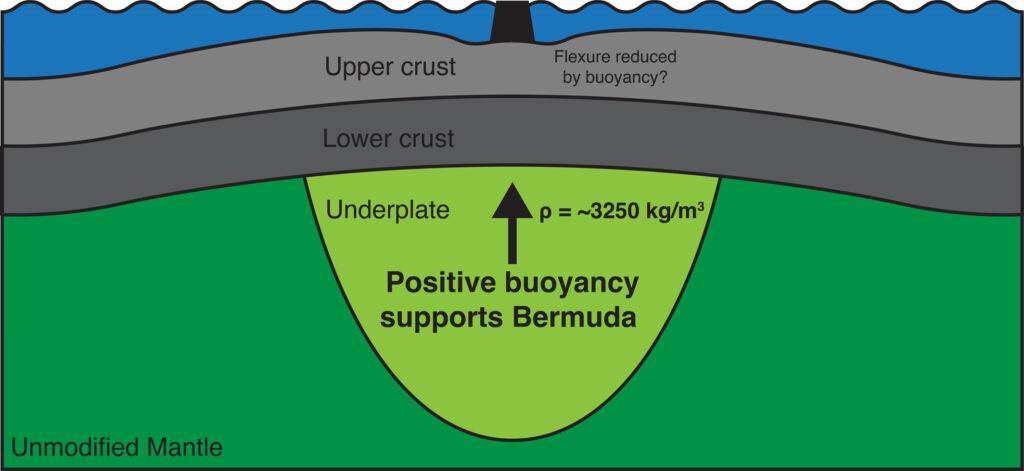
The researchers suggest the layer may be a remnant of Bermuda’s last volcanic episode. When magma rose beneath the island millions of years ago, it may have injected mantle rock upward into the crust, where it cooled and froze in place. The result would be something like a rigid raft embedded beneath the island, still providing lift long after eruptions ended.
Other scientists say the idea fits with what is already known about Bermuda’s unusual geology. Sarah Mazza, a geologist at Smith College in Massachusetts who was not involved in the study, noted that Bermuda’s volcanic rocks are low in silica, a sign that they formed from mantle material rich in carbon.
Mazza’s own research, published earlier this year in the journal Geology, suggests that this carbon came from deep within the mantle and may have been pushed there hundreds of millions of years ago, during the formation of the supercontinent Pangaea. That history sets Bermuda apart from islands formed above classic mantle hotspots in the Pacific or Indian oceans.
“This is different from what we see at hotspot-formed islands elsewhere,” Mazza said in the statement. Because the Atlantic Ocean opened as Pangaea broke apart, it is much younger than the Pacific or Indian oceans, and its mantle has been shaped by a different geological past.
“The fact that we are in an area that was previously the heart of the last supercontinent is, I think, part of the story of why this is unique,” Mazza said.
Also Read: Voyager 1 Is About to Reach One Light-day from Earth
The discovery leaves scientists asking whether Bermuda is an exception or whether comparable buried layers may exist beneath other islands but remain undetected.
Frazer is now examining seismic data from islands around the world to find out.
“Understanding a place like Bermuda, which is an extreme location, is important,” Frazer said. “It gives us a sense of what are the more normal processes that happen on Earth and what are the more extreme processes that happen.”
For now, the research suggests that Bermuda’s most enduring mystery is not a triangle on a map, but a massive slab of ancient rock quietly holding the island up from below.
The study was published in Geophysical Research Letters.