


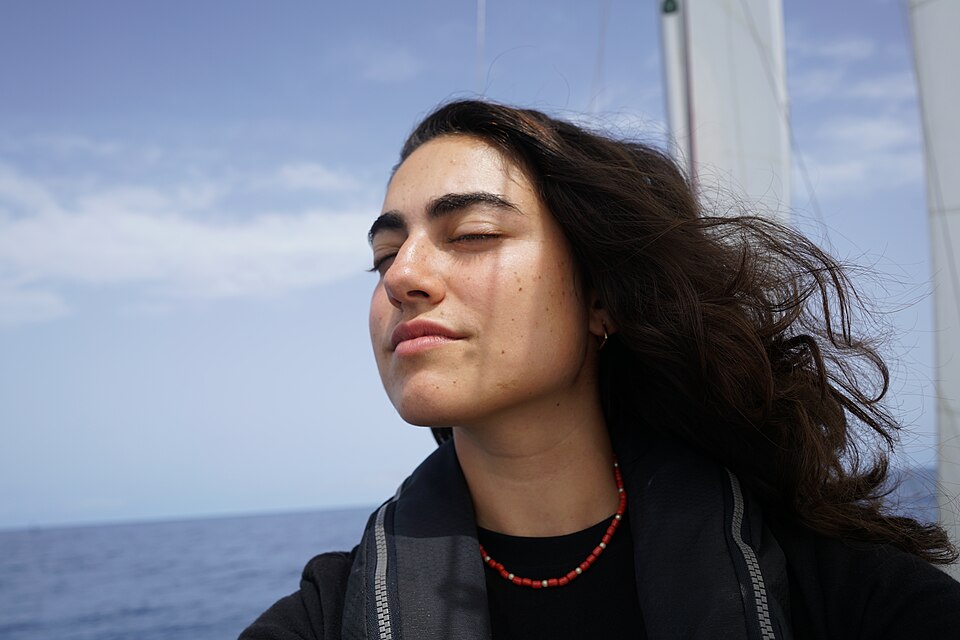
When Brazilian sailor Tamara Klink steered her small boat, Sardinha 2, into the icy waters between Greenland and Alaska, she wasn’t chasing a record alone — she was sailing through a changing planet.
At just 28 years old, Klink became the first Latin American and only the second woman to complete a solo voyage through the Northwest Passage, a 6,500-kilometre route that once defied all but icebreakers and steel-reinforced ships. She finished her two-month journey in September 2025, describing how she found sea ice on barely nine percent of the route — a fraction of what explorers faced only a few decades ago.
That emptiness on the water told its own story. The Arctic is melting, and fast. The UN’s climate report marked 2024 as the warmest year on record, with global temperatures surpassing 1.5 °C above pre-industrial levels for the first time. What once stood as a frozen barrier has become, in parts, an open corridor for small vessels like Klink’s.
Also Read: Carbon Offsets Play a Negligible Role in Corporate Climate Action
She said the thinning ice wasn’t just a scientific observation; it was something she felt and heard from Inuit hunters, fishermen, and scientists she met along the way — all noticing that each year, the freeze returns later and the thaw arrives earlier.
Klink’s story is also one of quiet persistence. She’s the daughter of Amyr Klink, the Brazilian adventurer who rowed solo across the South Atlantic. Yet, as she often points out, her father never handed her a boat or a manual: “My father had all the answers and he had all the tools, but by telling me he would not help me, he gave me the right to make mistakes and to learn how to be who I became.”
By twelve, she was already sailing; by 2021, she had crossed from Norway to Brazil alone in a modest second-hand vessel. Between 2023 and 2024, she spent eight months trapped in Greenland’s ice, her boat frozen under the northern lights — a long, cold rehearsal for what would come next.
Her Arctic crossing began in July 2025, threading through Canada’s Nunavut region and the Beaufort Sea before emerging into the Pacific. Her team notes she’s now the 14th person ever to complete the solo route. And through all that solitude, she insists the sea has no bias — “When I’m at sea, in my boat, I know that my gender does not matter. The sea doesn’t care if I’m female or male, if I’m old or young, if I’m strong or weak, if I’m there or if I’m not there anymore.”
The voyage arrives at a symbolic time. Brazil will host the 30th UN climate talks in November 2025, and Klink’s journey — shaped as much by determination as by melting ice — stands as a vivid reminder of what’s at stake. What allowed her to pass so freely through Arctic waters is the very thing the world must now work to prevent.
For Klink, the adventure ends with a warning as clear as the waters she crossed: the Arctic’s transformation isn’t just opening routes for sailors — it’s closing windows for action.