


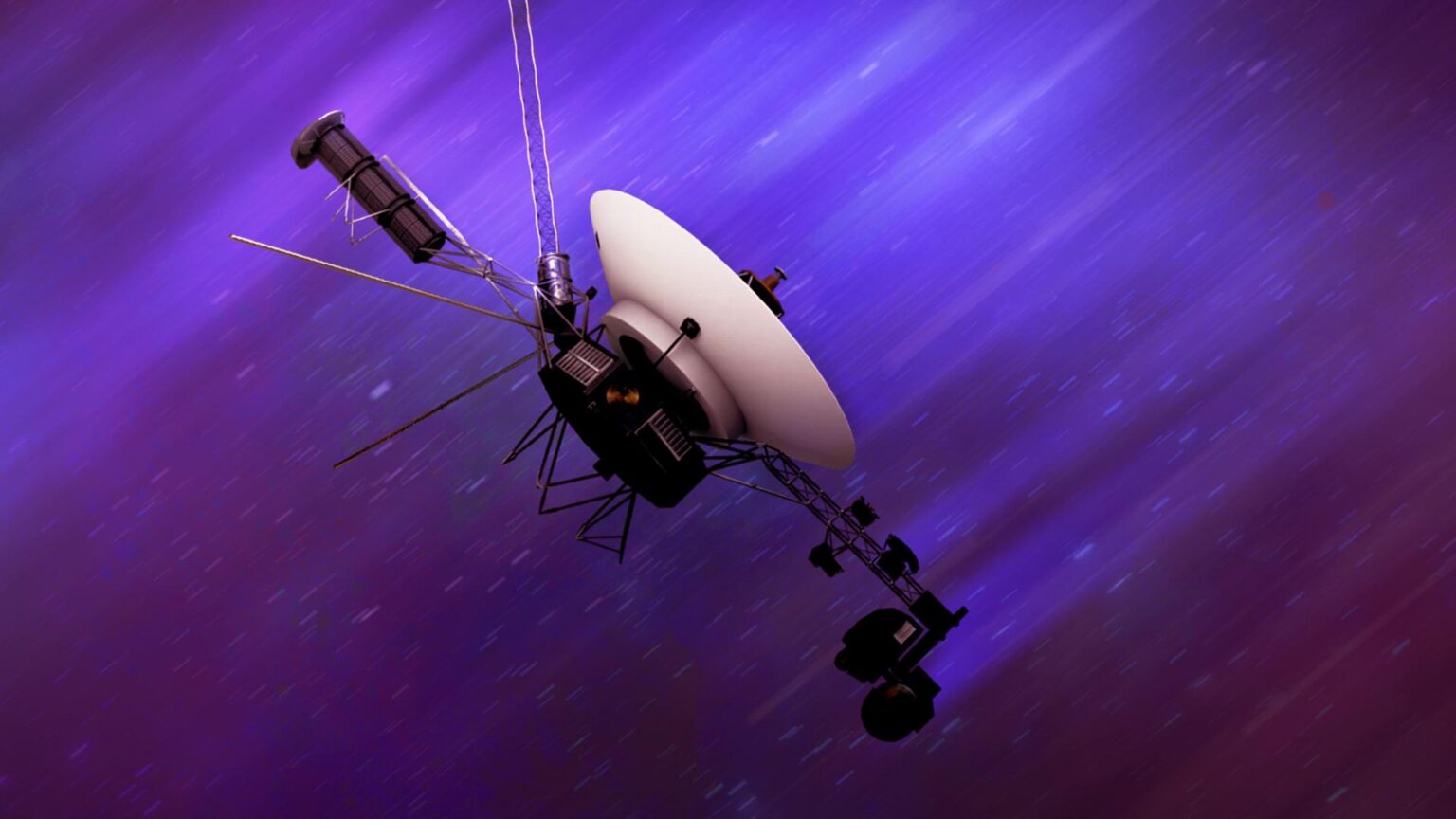
After nearly 50 years in space, NASA’s Voyager 1 is about to hit a historic milestone. By November 15, 2026, it will be 16.1 billion miles (25.9 billion km) away, meaning a radio signal will take a full 24 hours—a full light-day—to reach it. For context, a light-year is the distance light travels in a year, about 5.88 trillion miles (9.46 trillion km), so one light-day is just a tiny fraction of that.
Launched in 1977 to explore Jupiter and Saturn, Voyager 1 entered interstellar space in 2012, becoming the most distant human-made object ever. Traveling at around 11 miles per second (17.7 km/s), it adds roughly 3.5 astronomical units (the distance from Earth to the Sun) each year. Even after decades in the harsh environment of space, Voyager 1 keeps sending data thanks to its radioisotope thermoelectric generators, which will last into the 2030s.
"wait, that's real?"
Communicating with Voyager 1 is slow. Commands now take about a day to arrive, with another day for confirmation. Compare that to the Moon (1.3 seconds), Mars (up to 4 minutes), and Pluto (nearly 7 hours). The probe’s distance makes every instruction a patient exercise in deep-space operations. To reach our closest star, Proxima Centauri, even at light speed, would take over four years—showing just how tiny a light-day is in cosmic terms.

Voyager 1’s journey is more than a record for distance. From its planetary flybys to the iconic ‘Pale Blue Dot’ image, it reminds us of the vast scale of the solar system and the incredible endurance of a spacecraft designed to keep exploring, even without return.