


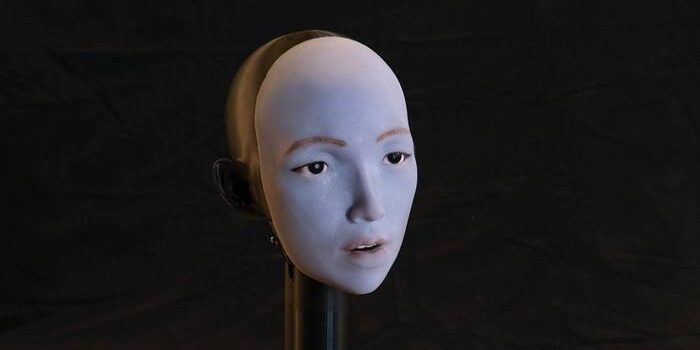
In a breakthrough that could finally bridge the “uncanny valley,” researchers at Columbia Engineering have developed a robotic face capable of learning realistic lip-syncing through the same observational methods used by human infants.
While the robotics industry has made massive strides in bipedal movement and manual dexterity, the subtle, high-speed dynamics of the human mouth have remained a persistent stumbling block, often leaving even the most advanced humanoids making little more than muppet mouth gestures.
The study, published in Science Robotics, demonstrates a learning-based approach in which a robot acquires realistic lip motion by observing human facial behavior rather than relying on predefined animation rules. “Something magical happens when a robot learns to smile or speak just by watching and listening to humans,” said Hod Lipson, co-author of the study.
Also Read: Humanoid Robot Kicks Its Trainer in the Groin
The system comprises a robotic head with 26 facial motors beneath flexible silicone skin. To establish a mapping between motor control and facial appearance, the robot initially generated thousands of random facial movements while observing itself in a mirror.
This process allowed the underlying “vision-to-action” language model to learn the relationship between internal motor activity and resulting facial motion. Following this, the robot was trained on hours of recorded videos featuring human speakers, enabling it to learn the complex relationship between speech sounds and the physical expression of the mouth.
By analyzing the relationship, the AI learned to map audio directly to motor movement, eventually allowing it to sync its mouth to a variety of languages. “We avoided the language-specific problem by training a model that goes directly from audio to lip motion,” Lipson explained, adding that for the AI, “there is no notion of language.”
Also Read: Teen Builds Fully Functional Robotic Hand from LEGO Parts
This achievement in facial affect is being described as the missing link for robots destined to work in elder care, education, and medicine, where emotional connection is as vital as physical assistance. Humans are biologically hardwired to focus nearly half of their attention on lip motion, and even a millisecond of lag or a malgesture can trigger deep unease.
While the current system still struggles with complex lip-puckering sounds such as “W” or “B,” the ability to translate raw audio directly into coordinated lip motion represents a clear shift away from predefined animation methods. “The more the robot watches humans conversing, the better it will get at imitating the nuanced facial gestures we can emotionally connect with,” said Yuhang Hu, who led the study.
As these systems are combined with conversational AI, the researchers say that more realistic facial motion could deepen the quality of interaction between robots and humans. The work represents progress toward crossing the uncanny valley, though Lipson warns that such technologies must be developed carefully to minimize the risks of their life-like realism.
The study is published in Science Robotics.