


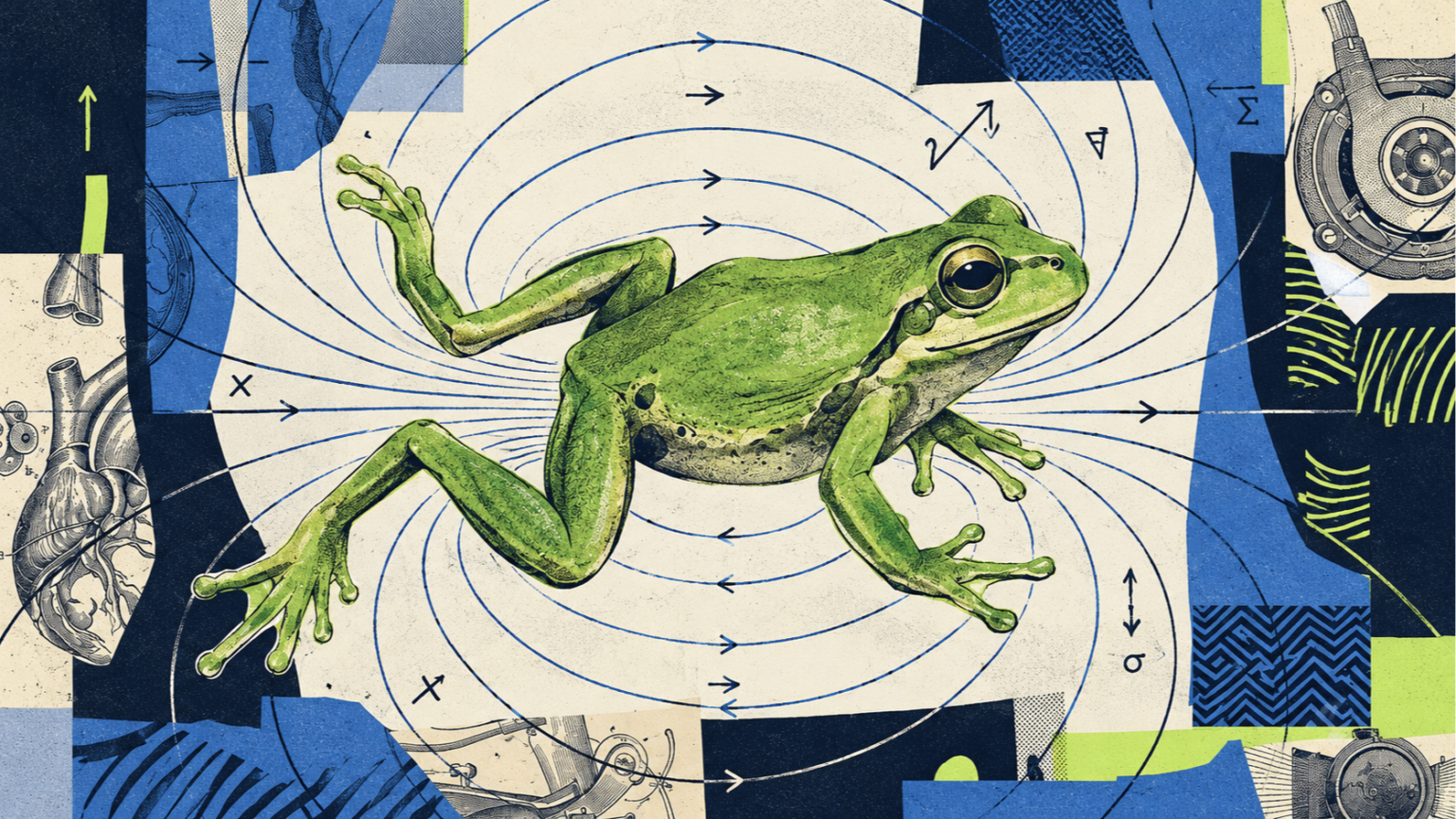
No need for a hook, you got it from the title. A frog floating in midair without any support already sounds sci-fi… Your first question is probably how it’s done, and if you’re anything like me, your second is whether the frog is okay.
The second question has the easier answer, so let’s deal with it first. The frog was fine. Years later, one of the physicists behind the experiment said they returned it to the biology department afterward, which is a pleasantly ordinary ending for an animal that had briefly defied everyday experience. The first question takes more explaining, so let’s go back to where the experiment began.
The experiment was published in 1997 by Andre Geim and Michael Berry, in a paper with the wonderful title “Of Flying Frogs and Levitrons.” Geim was a young professor at Radboud University in the Netherlands, and one Friday night in the lab, after a few beers, he was playing around with a powerful electromagnet that had a narrow tube running through its middle. He put some water into the tube and noticed that it was floating.
Also Read: How a Man Survived 3 Days Inside a Sunken Ship
If water would float, what else would? He tried strawberries and cherry tomatoes, and then his wife suggested a frog. When they put a live frog into the tube, it hovered there too, and so did a cricket and a few plants.
We know magnets work on magnetic things, like iron or cobalt. But a frog? It isn’t made of anything we think of as magnetic, so why would a magnet have any effect on it at all?
The answer is that everything is at least a little bit magnetic, because everything has atoms that contain electrons in motion. In a magnetic field, all matter pushes back a little, away from the magnet. The effect is called diamagnetism, and in materials like iron it gets overpowered by a much stronger effect called ferromagnetism. But in purely diamagnetic materials like water, and in most of what living things are made of, there’s nothing stronger in the way, so a very strong magnet pushes them away enough for you to see it happen.
To lift a frog, they used a magnetic field of about 16 tesla, roughly 1,000 to 10,000 times stronger than a refrigerator magnet or ten times stronger than an MRI machine. Basically, the push was strong enough to cancel out the pull of gravity on the frog, which is what held it in the air.


Now this experiment leads our curious minds to an obvious question: could this work on a human? I mean, can I really float like the frog in midair… really?
Well, in principle, the answer is yes. We are made of the same kind of stuff as the frog, so the same physics applies to us. The catch is that an average standing adult is about fifty to sixty times taller than the frog, and estimates say we would need a magnet with a steady field of 70 to 90 tesla, whereas the frog floated at just 16. The strongest steady magnets ever built reach only about 45 to 50 tesla, in a tube narrower than a golf ball, so nobody has a magnet that both fits a person and reaches that strength.
Then there’s the matter of powering it, since the frog’s magnet alone used about 4 megawatts. One big enough for a person would need about a gigawatt, which, mind you, is basically enough power to keep a city like San Francisco running continuously.
Also Read: Lightning Struck This Man 7 Times. He Survived Every Time.
And even if you could build such a machine, floating might feel rather strange and can be dangerous. The magnet wouldn’t hold every part of you equally, because your flesh, bones, etc. respond to it differently. As Michael Berry pointed out, you might feel as though your flesh were being held up while your skeleton hung down inside it. And if you have anything ferromagnetic in your body, like certain metal pins or implants — forget it. It’s gonna rip through your body and rush to the magnet.
But don’t lose hope yet. There’s a patent that proposes a way to float a person lying flat, and it needs a magnetic field of only 23 to 30 tesla. Lying down helps because the field then only has to act across the thickness of your body instead of your full height, and according to the patent it would be safe. It’s still just a design on paper, though, and it’s pitched not as a thrill-seeking device but as a medical one. And yeah, it’s not going to give you quite the same feeling the frog got, but it can still give you a taste of weightlessness.
Also Read: America’s Secret Plan to Nuke the Moon
Coming back to the experiment, Geim and Berry won an Ig Nobel Prize for it in 2000, a spoof of the Nobel for quirky research, and Geim went on to win the real Nobel Prize in Physics in 2010 for his work on graphene, which makes him the only person to hold both.
But the experiment turned out to be useful, too. Floating living things in a magnet is a cheaper way to mimic weightlessness than sending them into space, and researchers have used the same trick on frog eggs to see how low gravity affects their development. China even built a chamber that uses magnets to mimic the Moon’s low gravity, inspired by that floating frog.
So a frog floating in midair sounds like sci-fi, but it was only a very strong magnet pushing on the frog the way every magnet pushes on you, just far too faintly for you to ever feel it.
Story Sources: Harvard Gazette, IFLScience, Wikipedia – Andre Geim, Physics Stack Exchange, Deseret News, Science to Go, Journal of Physics Special Topics, ScienceAlert, Magnetics Magazine, Wikipedia – Magnetic Levitation, Space.com, Google Patents