

Ask someone what happens to your body in the vacuum of space and you’ll usually get one of two answers, that you freeze solid or that you swell up and burst like a balloon. For a long time even the people building spacecraft couldn’t say for sure, because nobody had ever tested it on a person.
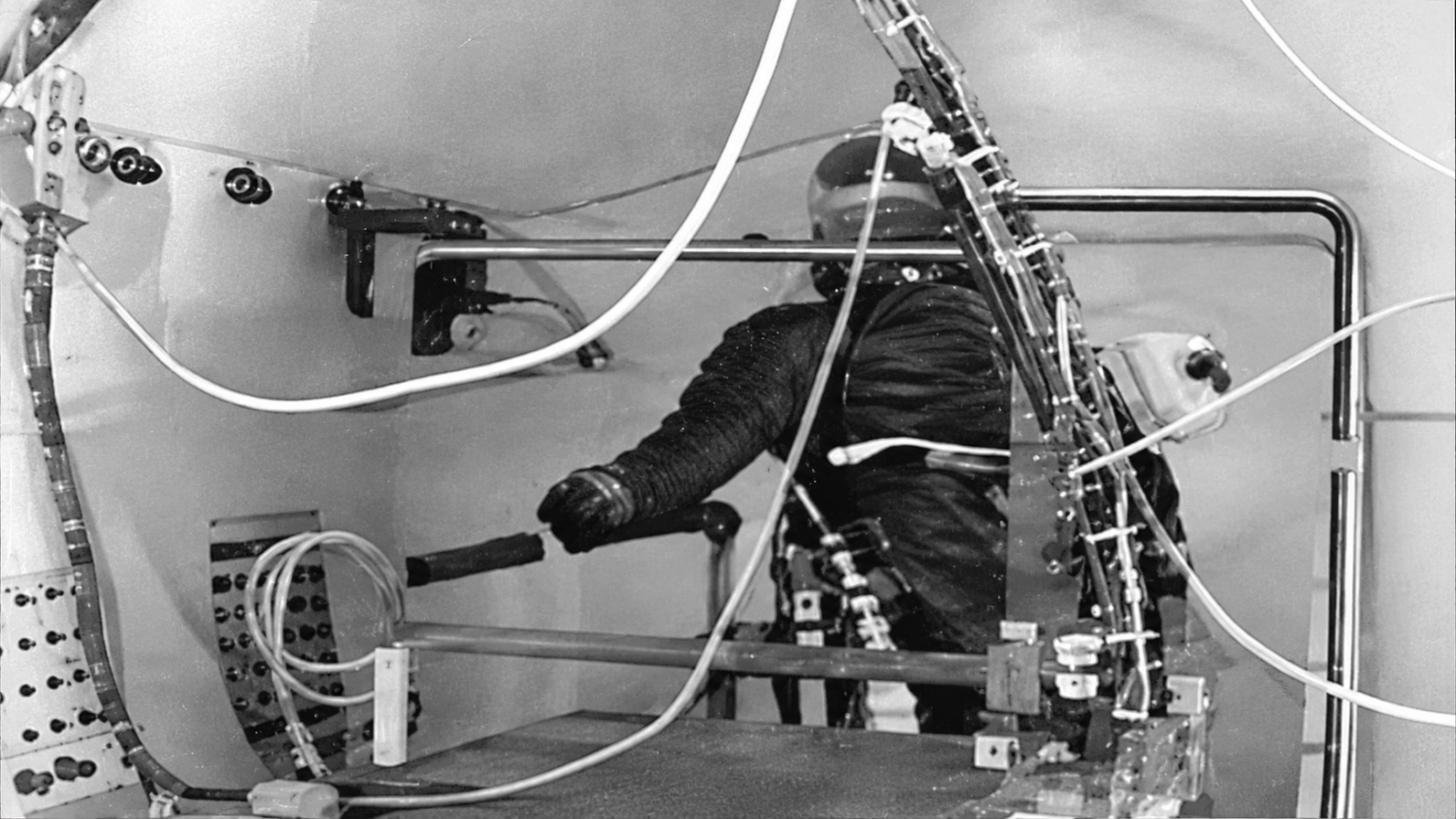
In the 1960s, while NASA was designing suits for the Moon, an accident gave a rare glimpse of what would actually happen. On December 14, 1966, in a huge vacuum chamber in Houston, an aerospace engineer named Jim LeBlanc walked in wearing a prototype Moon suit while the air got pumped out around him.
The suit was running at 3.8 psi, which is about a quarter of the pressure you’re sitting in right now, and for a while everything was good. Then the hose supplying the suit’s air somehow became disconnected, and in under ten seconds the pressure around his body fell from 3.8 psi to 0.1, roughly what you’d find 120,000 feet above the Earth.
LeBlanc stayed conscious for about 14 seconds, which was long enough to stumble backward and feel the saliva on his tongue start to bubble. Then he passed out, and that bubbling was the last thing he remembered.
Also Read: America’s Secret Plan to Nuke the Moon
If that bubbling sounds strange since nothing around him was hot, it’s simple physics. Water boils at lower temperatures as pressure drops, and above roughly 63,000 feet the boiling point falls below your own body temperature. The wet surfaces like the mouth and eyes start boiling, and the same thing happens quickly to the moisture in the lungs and under the skin.
All that vapor takes up far more room than the liquid did, so your body can swell to nearly twice its normal size, but skin and tissue are elastic enough to hold together, which is why the balloon-bursting idea turns out to be wrong.
What actually knocked him out was the lack of oxygen. The air in his lungs rushed out as the pressure dropped, so there was nothing left to breathe, and the lungs started pulling oxygen out of his blood instead of adding to it. That oxygen-poor blood reaches the brain in about ten seconds, causing a person to lose consciousness.
However, losing consciousness wasn’t necessarily fatal. Animal experiments had shown that recovery from this kind of exposure was usually complete if it lasted under about 90 seconds, and that after that the odds drop off fast. LeBlanc’s fate depended on the people outside the chamber, who had very little time to act. The problem was that bringing the chamber back to normal pressure usually took about 30 minutes. If everyone had followed the usual routine, LeBlanc wouldn’t have survived.
A technician named R. L. Clay didn’t follow the usual routine. He started repressurizing immediately after the suit failed, and the chamber’s pressure was back up to what you’d feel at about 14,000 feet in 87 seconds. LeBlanc woke up around then, just inside that 90-second line.
Hank Rotter, an engineer who was there, was the one who opened the door and cut away the suit’s malfunctioning part from him. Years later, Rotter said the real hero of that day was Clay, who acted at once and has mostly been forgotten since. He also said that he himself had remained calm during the emergency and only got shaken in the days afterward, once he had time to think about how close LeBlanc had come to dying.
LeBlanc came out of it with an earache and no lasting damage. Guinness World Records still lists his exposure to near-vacuum, at about 120,000 feet equivalent altitude, as the highest anyone has survived.
Also Read: The Crazy Experiment That Made a Frog Float in Midair
It’s worth remembering how differently this could have gone, and three cosmonauts in 1971 are the example. Georgi Dobrovolski, Viktor Patsayev and Vladislav Volkov were coming home after more than three weeks aboard the Salyut 1 space station when the explosive bolts separating their capsule from the rest of the spacecraft jolted a valve open at about 168 kilometers up. The valve sat hidden beneath their seats and they weren’t wearing pressure suits, so there was almost nothing they could do before the air escaped.
The capsule itself landed on target in Kazakhstan. The recovery team opened the hatch and found all three dead, still in their seats, with dark patches on their faces and blood trailing from their noses and ears.
Story Sources: Space Safety Magazine, Guinness World Records, Wikipedia, University of Houston, ABC Science, Astronomy.com