


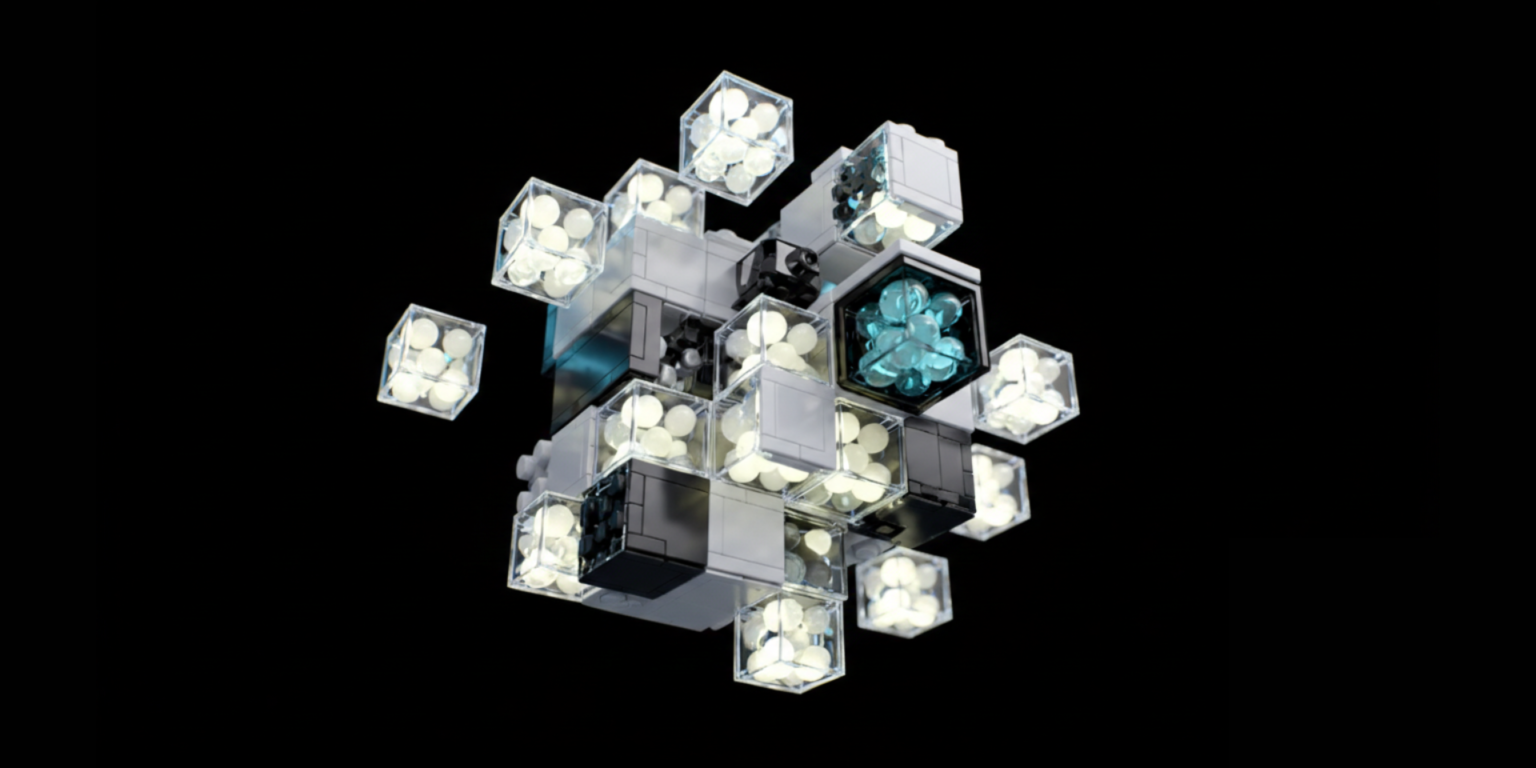
Think of a material that you can program to behave like a rigid plastic at one moment and a soft rubber the next, without changing its shape or being rebuilt.
That is the idea behind a new class of programmable materials developed by Duke University engineers. They have created LEGO-like building blocks that can change their mechanical properties in real time. By controlling whether tiny metal-filled chambers inside each block are solid or liquid, the researchers create patterns that let the same structure behave like different materials.
In their early demonstration, a tail-like 3D structure built from these blocks steered a robotic fish in different directions by changing its internal patterns, all with the same motor activity. In future robotics, this approach could simplify designs by moving part of the control into the material itself.
Also Read: Teen Builds Fully Functional Robotic Hand from LEGO Parts
This breakthrough centers on LEGO-like building blocks made from a soft elastomeric polymer called polydimethylsiloxane, or PDMS. Each block is about 10.5 millimeters across and contains 27 individually addressable chambers arranged in a 3×3×3 grid, forming a structure similar to a Rubik’s Cube. These chambers, known as voxels or cells, are filled with a liquid metal composite made of 95.2% gallium and 4.8% iron particles. This metal composite can exist in either a solid or liquid state at room temperature.
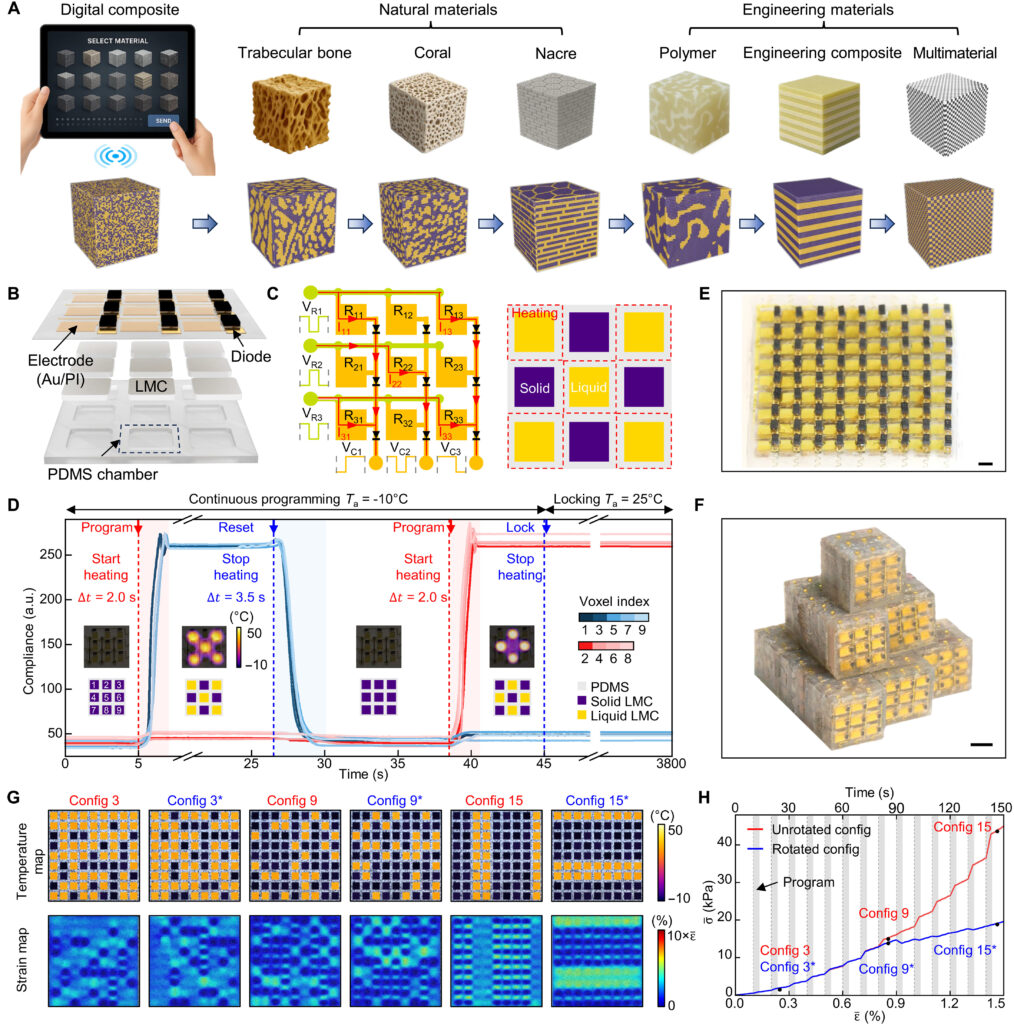
To switch the state of individual cells without affecting their neighbors, the researchers use a multiplexed circuit with flexible electrodes connected to each cell. Starting from a complete solid state, an electrical signal sent through selected electrodes locally heats the metal composite, switching a targeted cell between solid and liquid states while surrounding cells remain unchanged. This process is similar to writing and storing 0s and 1s in digital memory.
By creating different patterns, the researchers can programme how stiff, soft, or flexible the material becomes. “This gives us the flexibility to create 3D structures with different mechanical properties,” said Yun Bai, first author of the research. “And freezing the blocks at zero degrees resets all the cells to their solid state so that their configuration can be reprogrammed again and again.”
Also Read: Kawasaki’s Robot Horse CORLEO Is Turning Sci-Fi Into Reality
While the high-level instructions are sent wirelessly from a computer to a local Raspberry Pi controller, the actual delivery of the electrical current requires the material to be temporarily plugged into a custom physical socket.
The researchers use the analogy of human muscles to describe how the material changes its stiffness in real-time. These blocks do not move on their own via internal motors. Instead, they serve as a structural body that changes its mechanical properties to redirect motion. This approach could be especially useful in soft robotics, which aims to achieve movement while minimizing rigid components.
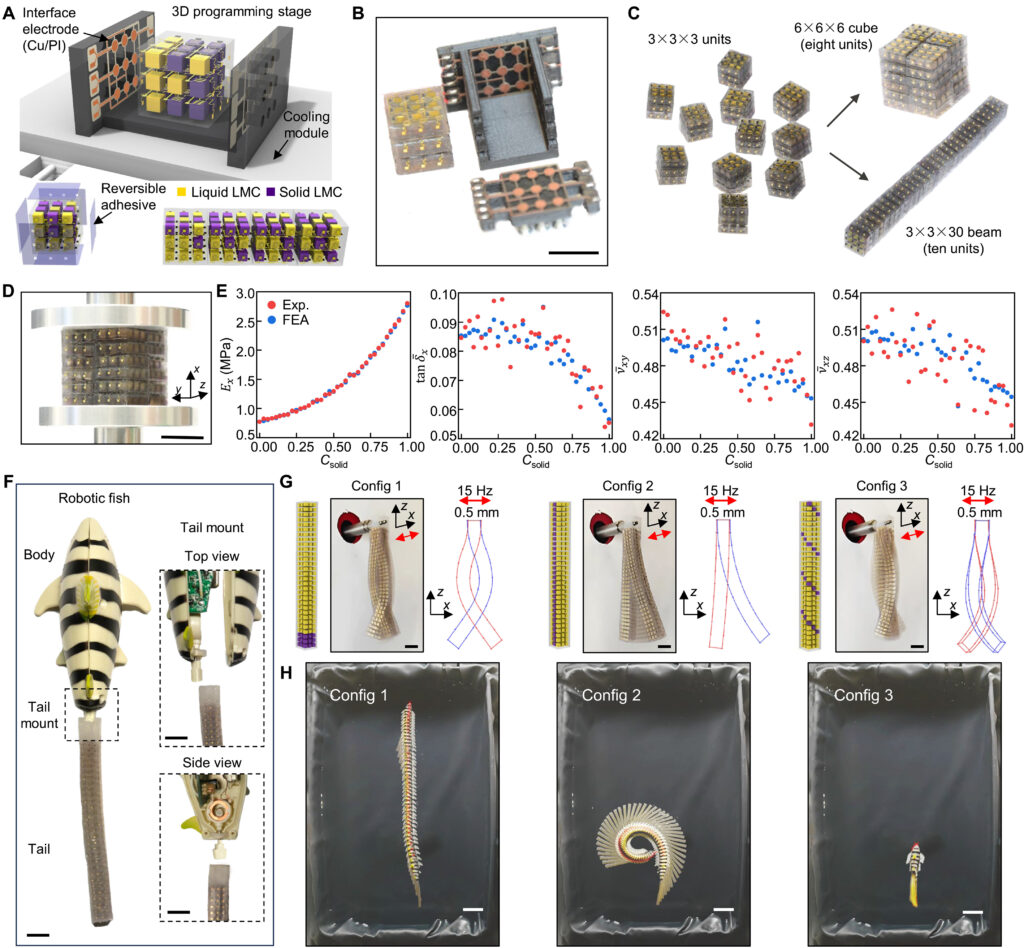
As demonstrated in the robotic fish experiment, the researchers connected 10 of these blocks to form a tail-like 3D structure, where specific cells were reprogrammed into different states. Changes in these patterns altered the fish’s swimming direction, even though the attached motor driving the tail operated identically every time.
Also Read: Robot Learns to Lip Sync by Watching YouTube Videos
However, the blocks are not yet suited for rapid motion through continuous reconfiguration. Currently, reprogramming takes about 3.02 ± 0.44 seconds, governed by the time required for the metal composite to fully solidify after heating. Addressing this limitation will become crucial as researchers look toward larger and more complex implementations in the future.
“Our goal is to eventually construct larger systems using the composite materials,” said Xiaoyue Ni, an assistant professor of mechanical engineering and materials science at Duke University. “We want to build flexible, programmable materials for robotics that can enable them to perform a wide variety of tasks in a wide variety of environments.”
The study is published in Science Advances.