


If you’ve ever looked at a Horizon Zero Dawn “Strider” or a Star Wars AT-RT and thought, “we’re nowhere near that,” Kawasaki is officially calling your bluff.
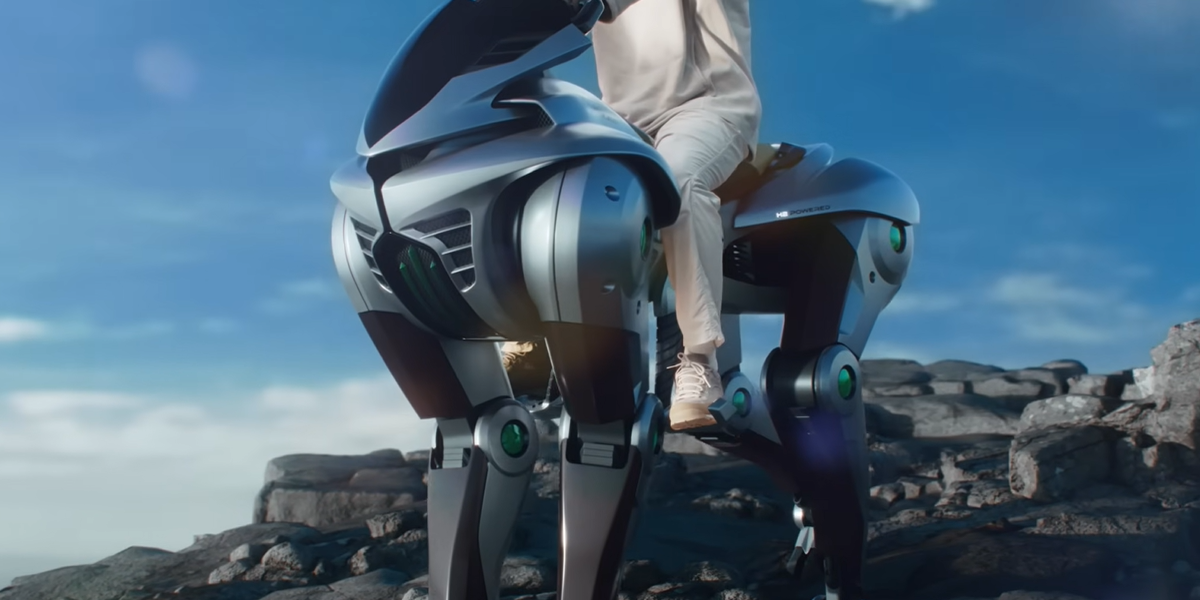
At Expo 2025 Osaka in Japan, the motorcycle giant unveiled CORLEO, a four-legged, rideable mobility concept that many have casually described as a “robot horse.” Designed for off-road terrain, the vehicle was introduced alongside a computer-generated video showing how legged movement could navigate environments where wheels struggle.
CORLEO has four independently articulating legs, with the rear leg unit free to swing separately from the front. That separation allows it to absorb impacts as it walks or climbs terrains, keeping the rider upright and looking ahead instead of bracing for every uneven patch of ground. Each leg ends in a hoof with a left-right divided structure made from slip-resistant rubber. These hooves can adapt to various terrains, gripping grass, rock, rubble, or snow without forcing a uniform stride.
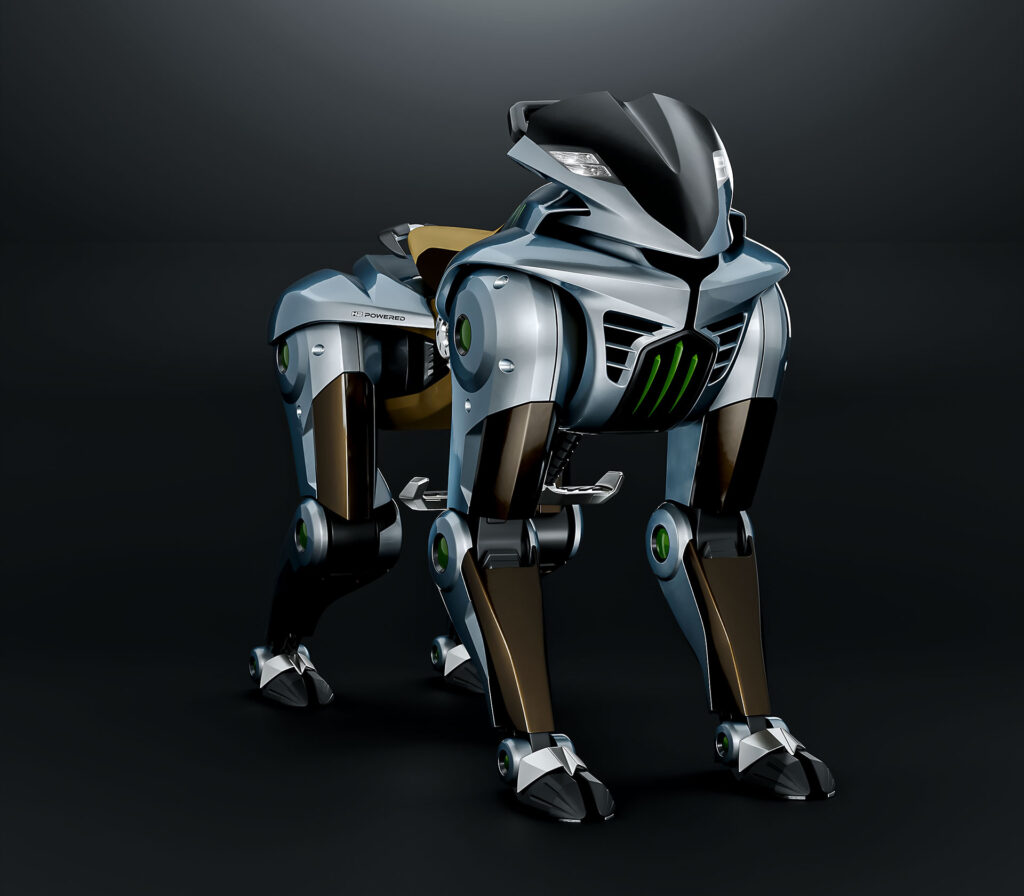
Kawasaki describes CORLEO as a new category of vehicle that preserves the joy of riding. Instead of relying on direct mechanical inputs, the rider guides the machine through subtle shifts in body weight, detected by sensors in the stirrups and handlebars. The system continuously monitors these movements to maintain a sense of unity between human and vehicle.
Also Read: Scientists Create Robotic Rabbits to Fight Invasive Burmese Pythons in Florida
Unlike most quadrupedal robots, such as Boston Dynamics’ Spot, which are fully battery-powered and meant to carry sensors or small equipment, CORLEO uses a 150cc hydrogen engine to generate electricity for its legs. This setup gives it longer range, greater endurance, and the ability to carry a human rider—capabilities that battery-only robots currently cannot match.
With a human rider involved, awareness becomes as important as power and balance. To support the rider, CORLEO is equipped with an onboard instrument panel that displays key information such as hydrogen levels, route guidance, and the vehicle’s center of gravity in real time. In low-light conditions, the robot horse goes a step further by projecting visual markers onto the ground ahead, highlighting the intended path and making night riding more predictable on uneven surfaces.
Also Read: AgiBot Q1: The Humanoid Robot That Can Easily Fit in Your Backpack
If you’re as excited to ride this beast as I am, you’ll need to keep your eyes on a slightly longer horizon. Kawasaki originally positioned CORLEO as a 2050 future concept, but the response at Expo 2025 appears to have accelerated those plans.
The company has now announced that it has begun work on the project by establishing a dedicated “Safe Adventure Business Development Team” that reports directly to the president—a clear sign that this is no longer just a conceptual exercise. A functioning prototype is planned to debut at Expo 2030 in Riyadh, Saudi Arabia, with a commercial launch expected as early as 2035.
For now, CORLEO exists as a sci-fi–style, rideable robotic horse, hinting at a future where legged mobility could become a real-world vehicle. Its hydrogen-powered legs, balance systems, and rider-guided controls are still in development, but the concept shows how ideas once confined to games and films are being engineered for reality.