



The Baghdad Battery — also called the Parthian Battery — is an artifact made up of a ceramic pot, a copper tube, and an iron rod, all fixed together with bitumen. It was unearthed in 1936 near the ancient city of Ctesiphon in present-day Iraq, and is believed to date from either the Parthian (150 BC–223 AD) or Sasanian (224–650 AD) era.
In 1938, Wilhelm König, then director of the National Museum of Iraq, suggested that the artifact was a galvanic cell — essentially an ancient battery — possibly used for electroplating or electrotherapy. The hypothesis was inspired by the object’s materials, which can produce an electrochemical reaction when an acidic liquid is added.
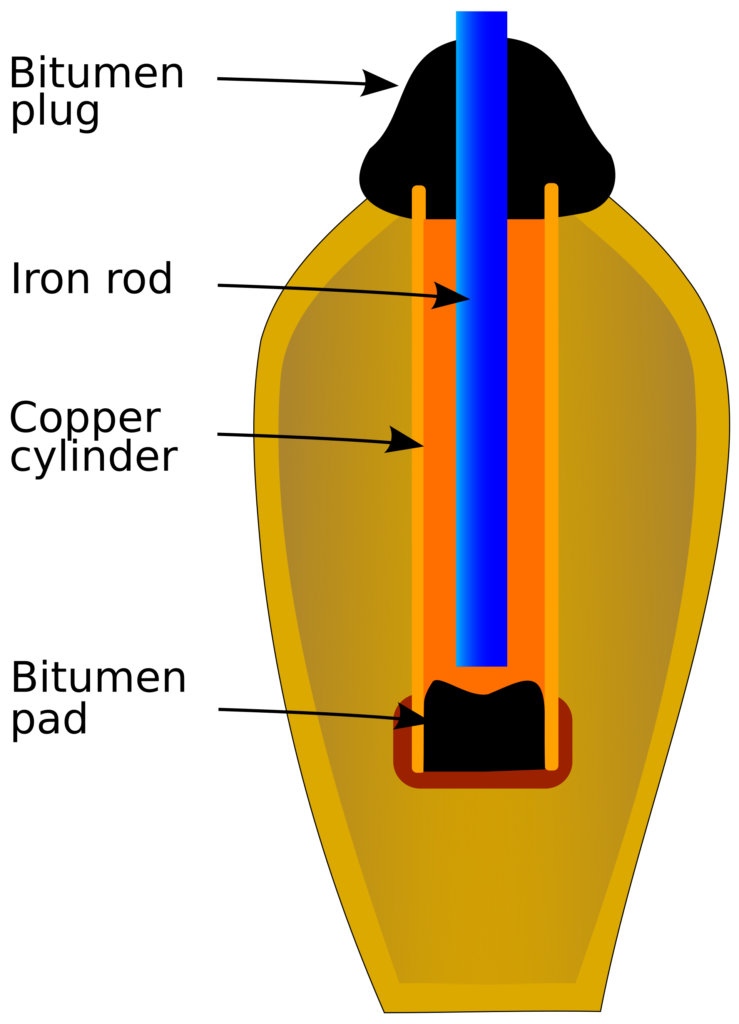
The idea captured popular imagination — MythBusters showed replicas could generate a small current with lemon juice as an electrolyte, and German scientist Arne Eggebrecht demonstrated that several cells connected in series could produce enough power to electroplate a very thin layer of gold on silver.
Also Read: The “Ghost” Flight: Helios Airways Flight 522
The practical problems, however, are significant. The artifact’s own design works against the theory, as sealing the copper cylinder in the way found archaeologically brought electricity production to a halt entirely; no connecting wires were ever found, and the bitumen seal would need to be broken every time the liquid was replenished.
Get top science news & stories delivered straight to your inbox.
Most archaeologists firmly reject the battery theory. There are no known electroplated objects from this period, and scholars point out that the artifacts were found alongside magical bowls associated with protection against demons, strongly suggesting they were containers for magical spells or incantations rather than electrical devices.
Further Reading: Discovery, Wikipedia, University of Houston