

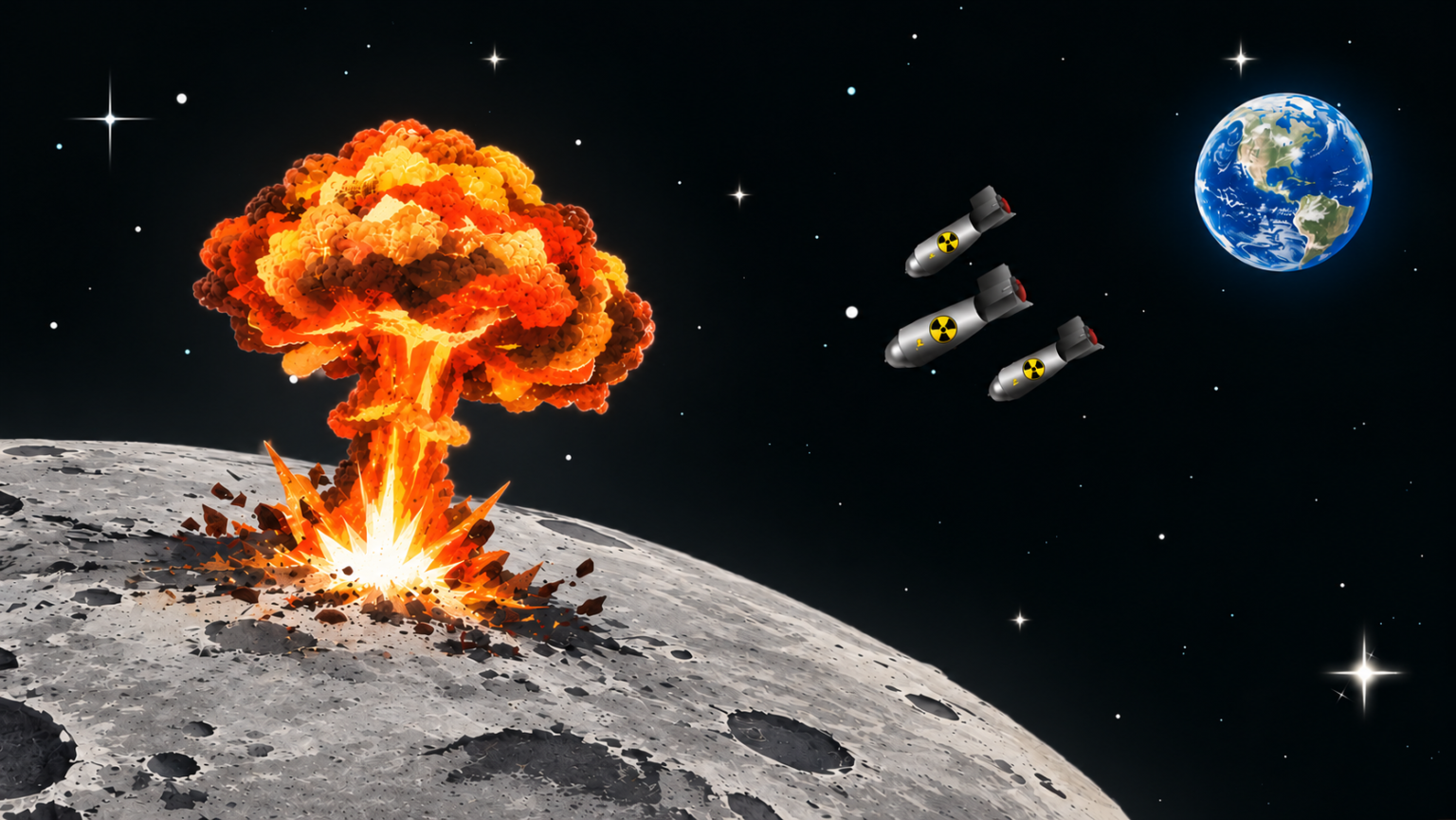
Let me tell you about the time the US Air Force seriously planned to detonate a nuclear bomb on the Moon, and I mean seriously, with a team of scientists on the job. The goal wasn’t to learn anything. It was so that you, or anyone else who happened to look up that night, could see it.
To understand how anyone landed on that idea, put yourself in October of 1957. You’re an American, you’ve always assumed your country was the one that invented the future, and then you hear on the radio that the Soviets have put a beach-ball-sized satellite into orbit. It’s called Sputnik. It beeps as it passes over your house, and the part nobody tells you at first is that the rocket that carried it was, for all practical purposes, an intercontinental ballistic missile.
Historian Vince Houghton, who has written a whole book on Cold War schemes that never happened, says the West was terrified at having been beaten at its own game. America had always seen itself as the big kid in science and technology, and suddenly it wasn’t. Washington wanted something so spectacular that the world would remember Sputnik as a blip.
Also Read: The Soviet Scientist Who Saved 200 Million Lives
What did the US Air Force come up with, within months? Of course. A nuclear bomb on the Moon.
But the idea wasn’t entirely out of nowhere. Newspapers had been running a rumor that the Soviets were planning to do the same thing, timed to the anniversary of the October Revolution, which coincided with a lunar eclipse on 7 November 1957. The rumor itself was never confirmed, but it was enough to make the Americans nervous about being second again.
So in May 1958 the Air Force quietly handed the job of researching the plan to the Armour Research Foundation in Chicago. They called it Project A119, with the far more boring official title “A Study of Lunar Research Flights”, and put a physicist named Leonard Reiffel in charge. Reiffel had spent years studying the environmental effects of nuclear explosions, so he knew the physics well, but he also knew he lacked the astronomy. So he recruited Gerard Kuiper, the planetary scientist whose name now sits on the belt of icy bodies beyond Neptune (Kuiper Belt, ohh… you know that). Kuiper brought along a doctoral student he thought would be useful, and that student was Carl Sagan.
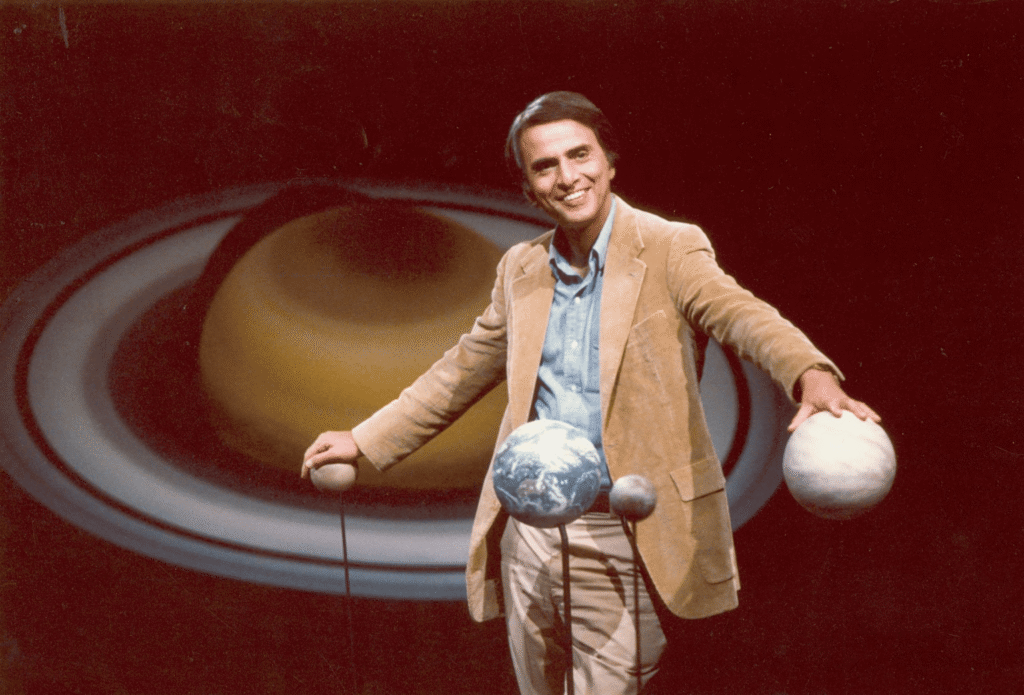
Yes, that’s Carl Sagan. Back then, he was just a young doctoral student, long before he became one of the great science communicators of the century. His job was the mathematics of how the dust cloud from the blast would spread out above the Moon, which mattered a great deal because the whole point was for people on Earth to see it. Some of the scientists, Sagan among them, also thought there might be real knowledge in it. A blast might reveal what lay beneath the surface, and it might even kick up organic molecules. (At the time, some scientists still believed there could be life on the Moon.)
Initially, they had considered a hydrogen bomb, but it was too heavy for the missile. So they settled on a small warhead, the W25, with a yield of around 1.7 kilotons. By comparison, the bomb dropped on Hiroshima was somewhere between 13 and 18 kilotons, so this was a modest device, and the aim was to detonate it on the Moon’s terminator, the line between day and night, so that sunlight would catch the rising dust against the dark. Reiffel wouldn’t say how the explosion would have been carried out, but he confirmed it was technically feasible, and that at the time an intercontinental ballistic missile could have hit a target on the Moon with an accuracy to within two miles.
So why didn’t it happen?
"wait, that's real?"
Well, we don’t know exactly why, and honestly it probably wasn’t one thing. The Air Force was worried about what would happen if the rocket failed and fell back to Earth. Reiffel was worried about possible nuclear fallout on the Moon. Some scientists were already saying that since we might walk on the Moon someday, maybe we shouldn’t blow the hell out of it first. Houghton points out, though, that Sputnik had frightened people so much that plenty of them were happy to argue the Moon was big enough that “we can nuke it and land on it at the same time.”
In the end, the simplest explanation may be the most appealing one, which is that someone realized landing a person on the Moon would be a bigger show, for the world and the Soviet Union alike, than blowing a hole in it.
Also Read: Surrounded by Food, Soviet Scientists Chose to Starve
If you’re wondering whether the Soviets were really planning the same thing, they were, in a project called E-4 (though its link to the rumor isn’t clear), and it was cancelled for similar reasons. Their engineers weren’t sure the rocket was reliable enough, and nobody wanted a warhead falling back onto Soviet territory.
You know, we almost never would have known any of this. For about forty years the entire thing stayed secret, until the writer Keay Davidson started researching a biography of Carl Sagan in the 1990s and found something odd in Sagan’s 1959 application for an academic scholarship at UC Berkeley. Sagan had listed the titles of two classified A119 papers, apparently without thinking much about it.
When Davidson’s book came out in 1999, Reiffel finally spoke up, writing to the journal Nature in 2000 to confirm the story, and arguing that Sagan had breached the project’s secrecy. By the time anyone went looking, the project’s reports were gone. All eight of them had been destroyed in 1987, and the US government has never officially acknowledged its involvement in the project.
Also Read: How a 17-Year-Old Nearly Built a Nuclear Reactor in His Backyard
When Reiffel talked publicly, he didn’t defend the project. He said, “I am horrified that such a gesture to sway public opinion was ever considered.” Nuclear historian David Lowry made the point that stuck with me the most. He said if the plan had gone ahead, the first contact humans would ever have had with another world would have been a nuclear explosion, and we would never have had the romantic image of Neil Armstrong stepping onto the Moon and saying:
That’s one small step for man, one giant leap for mankind.
Story Sources: The Guardian, Wikipedia, BBC, History, ABC