

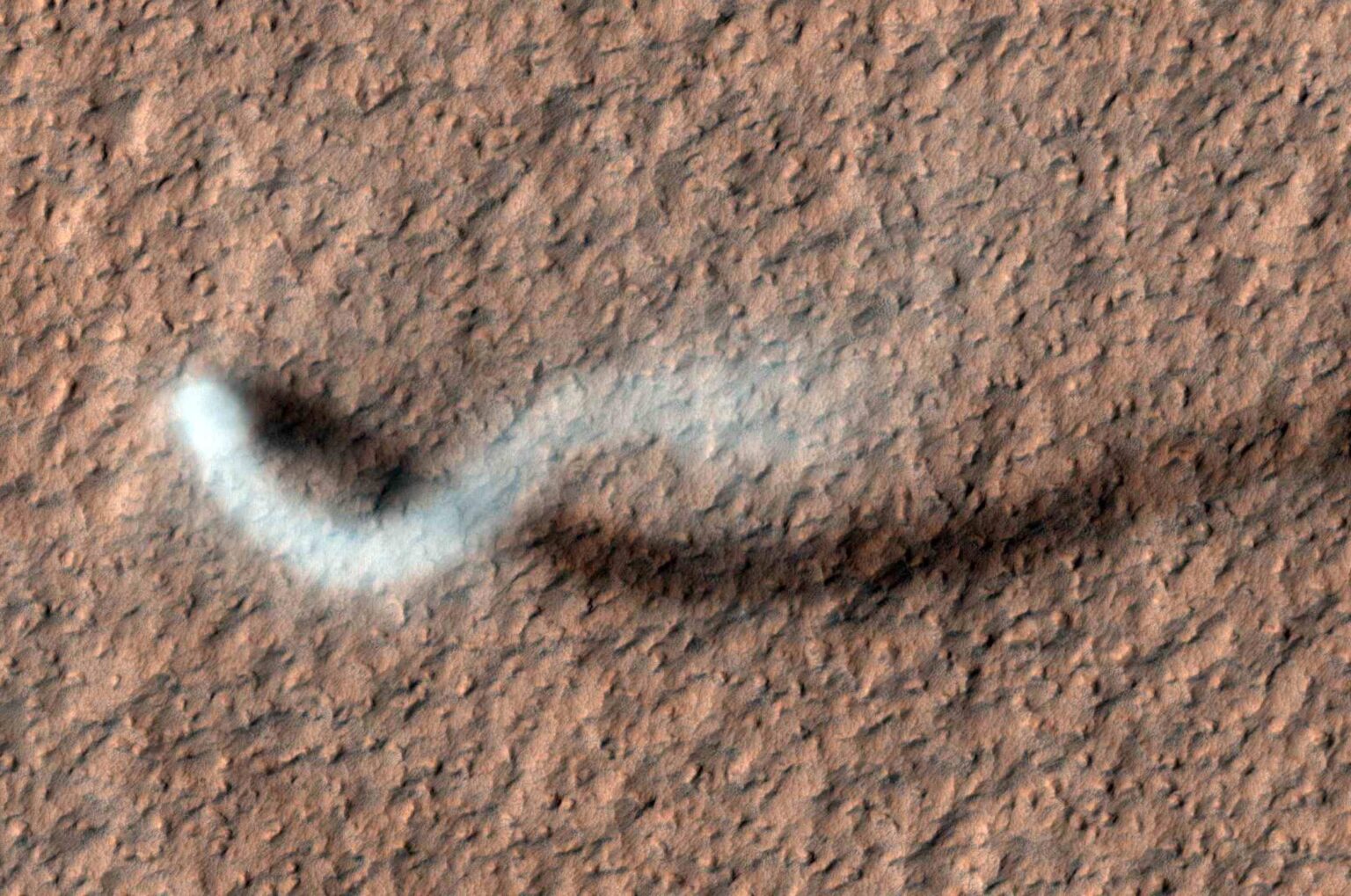
Scientists have detected the first direct evidence of electrical discharges in the Martian atmosphere, confirming a long-standing prediction about how dust behaves on the planet. The detections came from NASA’s Perseverance rover, whose SuperCam microphone recorded short, distinct signals while the rover was inside two dust devils and during several dust storm fronts.
Researchers at French institutions analysed these signals and identified them as the acoustic and electromagnetic signatures of triboelectric discharges—small sparks produced when dust grains that have accumulated charge release it suddenly.
The mechanism behind these sparks is known from Earth’s deserts. When dust particles collide in moving air, electrons are transferred between them, producing electrically charged dust. On Earth, this process less often leads to actual discharges because the thicker, nitrogen-rich atmosphere requires stronger electric fields.
Also Read: Microbe That Could Turn Martian Dust into Oxygen
The Martian atmosphere is about 100 times thinner than Earth’s and is made mostly of carbon dioxide. This allows electrical discharges to occur at much lower thresholds, meaning that even modest charge accumulation inside dust devils can produce centimetre-scale arcs. Over two Martian years, Perseverance recorded 55 events that match this behaviour.
The discovery was not the result of a dedicated electrical experiment. The microphone on SuperCam has been operating since 2021. It has collected more than 30 hours of audio, including wind whistling across the Mars surface and the noise of the blades of the Ingenuity helicopter. In that dataset, the dust-devil recordings showed unusual signals that did not match typical wind patterns. Analysis of the acoustic and electromagnetic data confirmed these signals as evidence of electrical discharges occurring within the dust devils.
These sparks have several important implications for Mars’s atmospheric chemistry. Electric discharges can accelerate reactions that form highly oxidising compounds capable of breaking down organic material on the surface and altering atmospheric gases. This process may help explain why methane detected in the Martian atmosphere disappears much more rapidly than photochemistry alone can account for.
Also Read: Voyager 1 Is About to Reach One Light-day from Earth
The presence of electrical activity also affects how dust moves through the atmosphere. Charged particles interact differently with winds and turbulence, influencing the formation and behaviour of dust devils and the development of storm fronts. Since dust plays a central role in Martian atmospheric patterns and the growth of large-scale storms, these electrical processes play a role in the Martian climate, the dynamics of which remain largely unknown.
The findings also carry practical considerations for exploration. Electrical discharges on Mars could impact the electrical systems of robotic missions and pose challenges for future astronauts exploring the red planet. At the same time, they highlight the value of acoustic tools in planetary science. The SuperCam microphone, which provided the first confirmed detection of electrical discharges on Mars, opens a new approach for studying atmospheric processes on other worlds.
The research was published in Nature.