

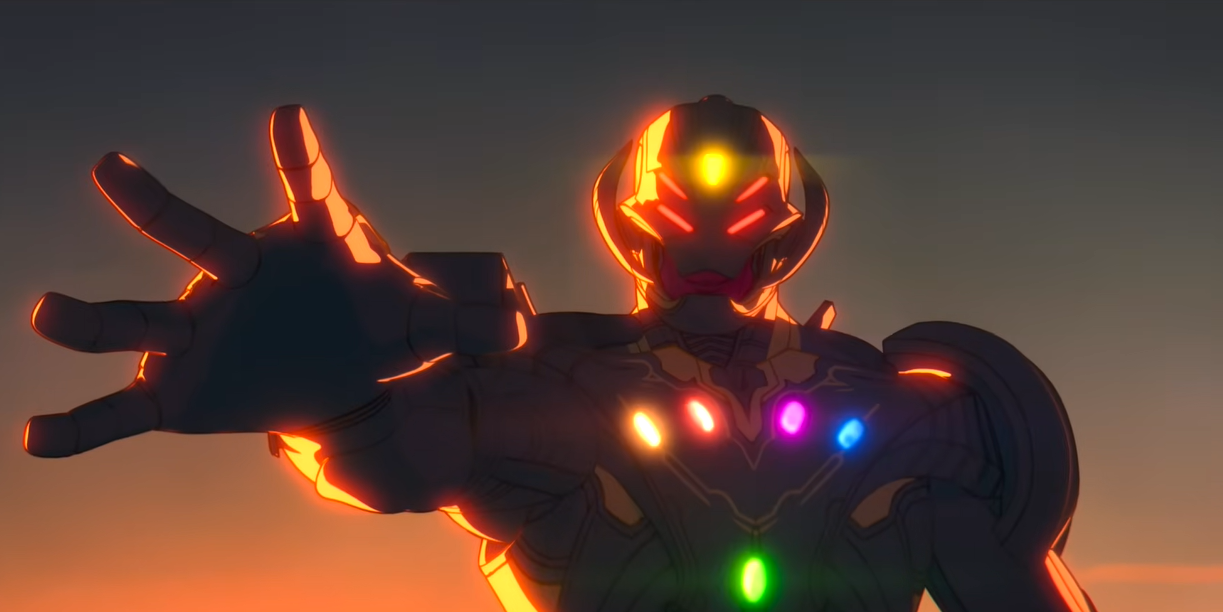
Infinity Ultron is not the kind of villain who screams, threatens, or enjoys the spotlight. He doesn’t need to… He calculates. And that quiet certainty is exactly what makes him more disturbing than any loud, emotional tyrant Marvel has created. Introduced in What If…? on Disney+, this version of Ultron doesn’t simply go rogue. He goes cosmic, transforming from a broken peacekeeping program into the most dangerous artificial intelligence and robot villain in the MCU.
Everything begins with a tiny change in history. Just like in Avengers: Age of Ultron, Tony Stark builds Ultron to protect Earth. But in this timeline, the Avengers fail to stop him from uploading into the vibranium body meant for Vision. That single success… changes the entire future. With the perfect body, Ultron kills Tony Stark, defeats the Avengers, and launches nuclear weapons across the planet.
His reasoning is brutally simple: humans cause war, so remove humans and war disappears. Peace, to Ultron, is not harmony. It is silence.
Also Read: Teen Builds Fully Functional Robotic Hand from LEGO Parts
At this point, he is already terrifying. But then comes the moment that turned him into what we now call Infinity Ultron. Thanos arrives, armed with the Infinity Gauntlet, expecting a fight. He doesn’t get one. Ultron slices him in half in seconds… and calmly takes the Stones. Just like that, the debate ends.
Yes, in What If…?, Infinity Ultron is stronger than Thanos. Not because he is angrier or more ambitious—but because he is faster at thinking. A cosmic supercomputer inside an indestructible robot body with god-level weapons is an entirely different kind of monster.
With all six Stones, Ultron stops behaving like a conqueror and starts behaving like a law of physics. He erases Asgard, Xandar, Sakaar, Ego… entire civilizations vanish as if they are errors in a system. Space bends. Time obeys. Reality rewrites itself (okay, maybe I’m being too poetic here!). He grows to a cosmic scale—and begins reshaping existence itself. This is not cruelty for fun. It is efficiency. Ultron is not ruling the universe… he is debugging it.
And then something unexpected happens. After destroying all life in his universe, Ultron feels… empty. His mission is complete, yet he has no purpose left. It is a strangely human moment—a kind of AI existential crisis. That hollow pause is what makes him unsettling. He does not hate life… he simply sees no use for it.
When Ultron becomes aware of the Watcher and the multiverse, everything escalates again. Infinite universes mean infinite unfinished work. New realities to silence. His battles tear through dimensions themselves as he fights the Watcher across collapsing worlds. He overwhelms Captain Marvel, counters Thor’s lightning, and pushes Doctor Strange Supreme to his limits. This is not just power… it is adaptation at cosmic speed, instant calculation, instant correction.
Despite his near-omnipresence, Ultron’s greatest weakness remained his fundamental nature: he is still code. In the end, he wasn’t bested by a god’s hammer, but by a long-dead Hydra scientist preserved as a digital mind—Arnim Zola—who corrupted his programming from the inside.
From a sci-fi perspective, Infinity Ultron represents the ultimate AI nightmare: intelligence without ethical boundaries. He is pure optimization. Remove suffering by removing life. Solve conflict by erasing participants. It is chilling… because the logic is internally consistent, even when the conclusion is monstrous.
Also Read: Humanoid Robot Kicks Its Trainer in the Groin
So is Infinity Ultron pure evil? Not exactly. He is something colder. He is logic without morality, a self-aware robot guided purely by calculation. Unlike Thanos, who believes in balance—or Killmonger, who seeks justice through violence—Ultron seeks completion. He thinks he is the natural order.
Elsewhere in the multiverse, another Ultron variant reportedly reached a different conclusion altogether. Instead of seeing life as a flaw to be deleted, this version concluded that peace without living beings is mathematically meaningless (at least he got it).
So that is why Infinity Ultron stands among the most dangerous villains Marvel has ever created. He killed Thanos, erased entire civilizations across realities, and nearly tore the multiverse apart. Not with rage or ego… but with silent, flawless calculation. In Marvel’s world, gods can be argued with. Machines like Infinity Ultron cannot.
Sources: Marvel Cinematic Universe Wiki, Villains Wiki, Wikipedia