


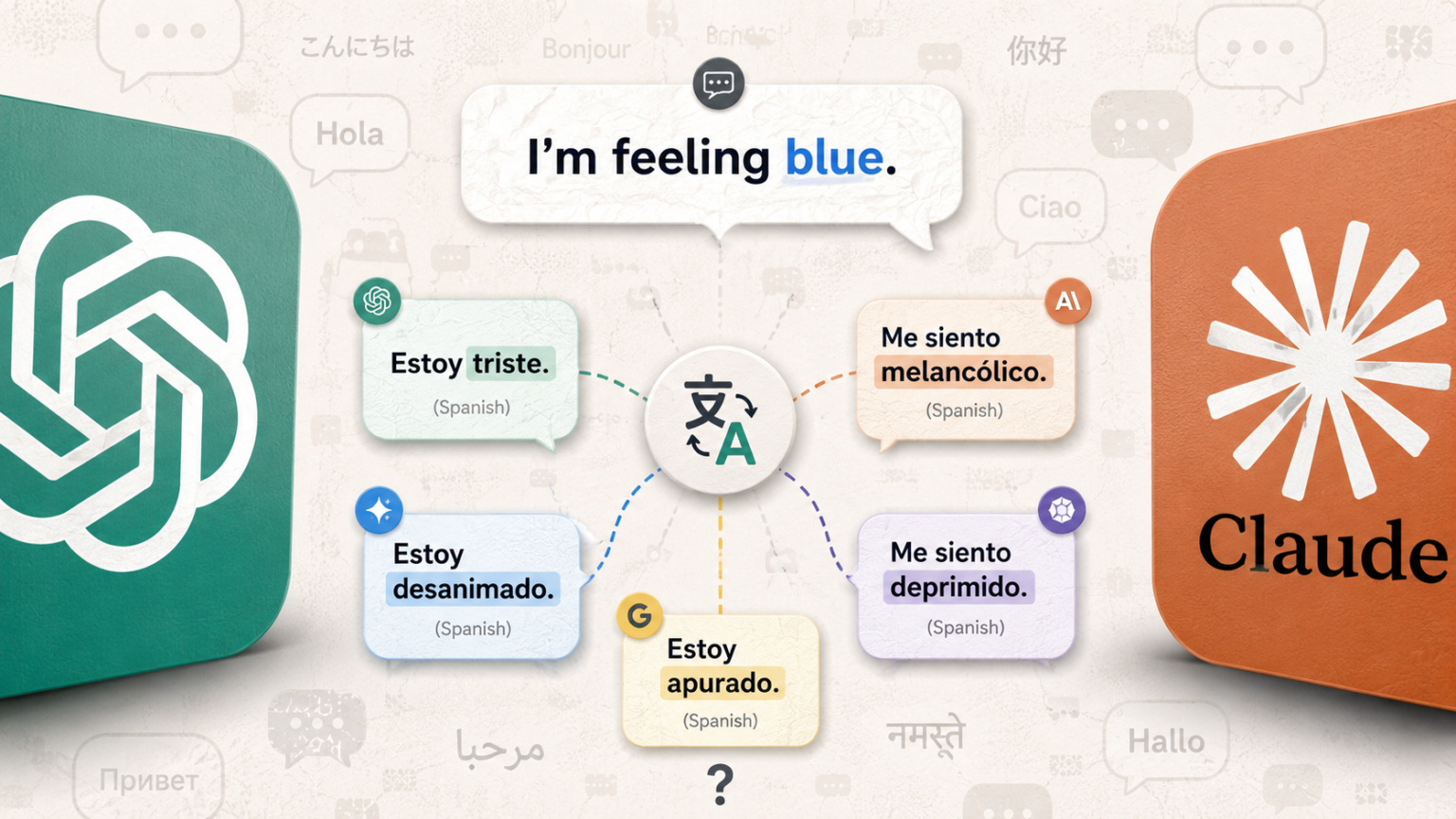
Copy a sentence. Paste it into Google Translate. Note the result. Now paste the exact same sentence into DeepL. Or ChatGPT. Or any other AI model.
In many cases, you will get a different answer.
Not dramatically different, necessarily. But different enough to matter: a word swapped, a phrase reordered, a meaning subtly shifted. And if you run the same sentence through ten or twenty different AI translation engines, you will almost certainly not get the same output twice.
This is not a bug in any individual system. It is a fundamental property of how modern AI translation works. Understanding why it happens reveals something genuinely surprising about the nature of language itself.
The Disagreement Is Real, and It Scales
Language has never had one correct answer. The word ‘sad’ in English could become triste, traurig, or melancolíco in Spanish or German depending on context, register, and the translator’s judgment. Human translators have always disagreed. What changed is that AI systems were disagreeing in ways that went largely unnoticed, until researchers started running systematic comparisons.
A 2025 study from Deakin University analyzed roughly three million text outputs across twelve leading large language models from OpenAI, Google, Microsoft, Meta, and Mistral. The researchers found that writing styles and translation outputs varied significantly across models, with some, including GPT-4, generating considerably more varied responses to the same prompt than others.
A separate 2026 analysis of large language model deployment noted the same pattern from a practical angle: the same input text can produce different translations across multiple runs of the same model, let alone across different ones. Variation is not an edge case. It is structural.
Also Read: AI Reported a Police Officer ‘Turned Into a Frog’
Why AI Translation Models Produce Different Outputs
To understand why AI models disagree, it helps to understand what they are actually doing when they translate.
Modern neural machine translation systems do not look up words in a dictionary. They learn the statistical relationships between billions of word sequences in a source language and their likely counterparts in a target language. When you ask one of these models to translate a sentence, it is not retrieving a single correct answer from memory. It is generating the most probable sequence of words in the target language given the input which is a fundamentally probabilistic process.
That means two things. First, different models trained on different data will arrive at different probabilities. Second, even the same model can produce different outputs on different runs, depending on how it samples from those probabilities. Researchers describe the disagreement as existing along a spectrum: models that are highly confident about a translation produce consistent outputs; models that face genuine linguistic ambiguity will vary.
Ambiguity is more common than most people expect. Tonal languages, idioms, gendered nouns, formal versus informal registers, domain-specific jargon, these all create forks in the road where different models take different paths. None of them may be wrong. Several may be right.
The model does not tell you when it is uncertain. It just gives you an answer that looks equally confident regardless of whether it was the only possibility or one of several competing interpretations. Research into how people perceive AI confidence finds that a fluent, deliberate-sounding output is consistently rated as more trustworthy by humans and by other AI systems even when accuracy is held constant. Translation is no different: a smooth output can mask genuine uncertainty about which of several valid interpretations was chosen.
What Consensus Can Actually Do
In computational research, disagreement across multiple models is not always a problem. Sometimes it is a signal.
The logic comes from ensemble methods in machine learning. A well-established approach where combining the outputs of multiple models produces results more reliable than any single model on its own. The intuition is straightforward: if three models give you the same answer and one gives you a different one, the outlier is probably wrong. If all four agree, you can be more confident. If they all diverge, you are dealing with something genuinely ambiguous and should look more carefully.
Some translation tools have begun applying this logic directly. Rather than routing a sentence through one engine and returning the result, they run the same text through multiple AI models simultaneously and surface whichever output achieves the strongest agreement across them. The underlying principle, which is that cross-model consensus is a proxy for reliability, is the same one used in ensemble forecasting, clinical panel review, and scientific replication. MachineTranslation.com, an AI translator, is one example of this approach, running text through 22 AI models simultaneously and selecting the translation the majority agree on.
The practical effect is that convergence across independent models becomes a quality signal. Parts of a translation where the majority agree can be accepted with confidence; parts where the models diverge flag areas that genuinely warrant a second look.
This reframes the question from ‘which AI should I trust?’ to ‘where do multiple AIs converge?’. That is a shift that turns model disagreement from a liability into diagnostic information.
Also Read: This New AI Lets Robots “Imagine” How Objects Will Move Before Acting
The Same Principle Shows Up in Other Sciences
The idea that disagreement between independent observers reveals something useful is not unique to computational linguistics. It appears throughout science.
In astronomy, parallax or using the disagreement between two observation points to calculate distance, turns the very fact of disagreement into a measurement tool. In clinical medicine, diagnostic disagreement between practitioners flags cases that need additional scrutiny. In peer review, conflicting referee reports identify papers that warrant deeper investigation.
The same structure has appeared in adjacent AI research. An AI agent tested at Stanford outperformed most human penetration testers by launching multiple simultaneous sub-agents to investigate different vulnerabilities in parallel, an ensemble approach where independent passes over the same problem surface what a single pass misses.
In all of these cases, variation across observers is informative. It tells you something about the object being studied that a single observer cannot.
Translation disagreement works the same way. When most AI models render a phrase identically, that convergence is evidence of a reliable output. When they scatter across several different renderings, the source text is probably doing something unusual, a double meaning, a cultural idiom, a technical term that sits uncomfortably in the target language, and that ambiguity deserves closer attention.
Also Read: AI Successfully Controls Satellite Attitude in Orbit for the First Time
What This Means If You Use AI Translation
For most everyday uses, a single AI translator is fine. Translating a casual message, checking whether a foreign-language document is roughly what you expect. The disagreement between models at this level rarely produces consequences.
But in contexts where precision matters, the single-model approach introduces a blind spot. Medical documentation, legal contracts, product safety instructions, academic research are domains where the difference between triste and melancolíco, or between the formal and informal register of a Japanese imperative, can materially change what the text means and how it is received.
The core limitation is this: a model that produces a fluent-sounding translation and a model that happens to have the right training data for a specific domain look identical from the outside. Without running multiple models and comparing, you have no signal about whether the output you received was the clear choice or one of several plausible guesses. That gap between fluency and accuracy is harder to see as AI tools become more embedded in everyday workflows, where translation outputs feed directly into decisions, communications, and user-facing content with little opportunity for review.
The Science of Not Picking Just One
Language is ambiguous in ways that no single model can fully capture. Different AI systems are trained on different data, use different architectures, and make different probabilistic choices. None of them is correct in the way that 2 + 2 = 4 is correct. They are each making educated guesses, and sometimes, more often than most users realize, the educated guesses differ.
That is not a failure of AI. It reflects a genuine property of language. Translation has always involved judgment calls. AI has made those judgment calls faster and cheaper. But it has not made the underlying ambiguity disappear. It has just made it easier to ignore.
The more interesting question is not which AI to use for translation. It is what the pattern of agreement and disagreement across many AI translators tells you about the text you are trying to translate. That information, it turns out, is right there in the disagreement itself, if you know how to look.
This article was contributed by Tomedes/MachineTranslation.com and published in collaboration with ScienceClock.