


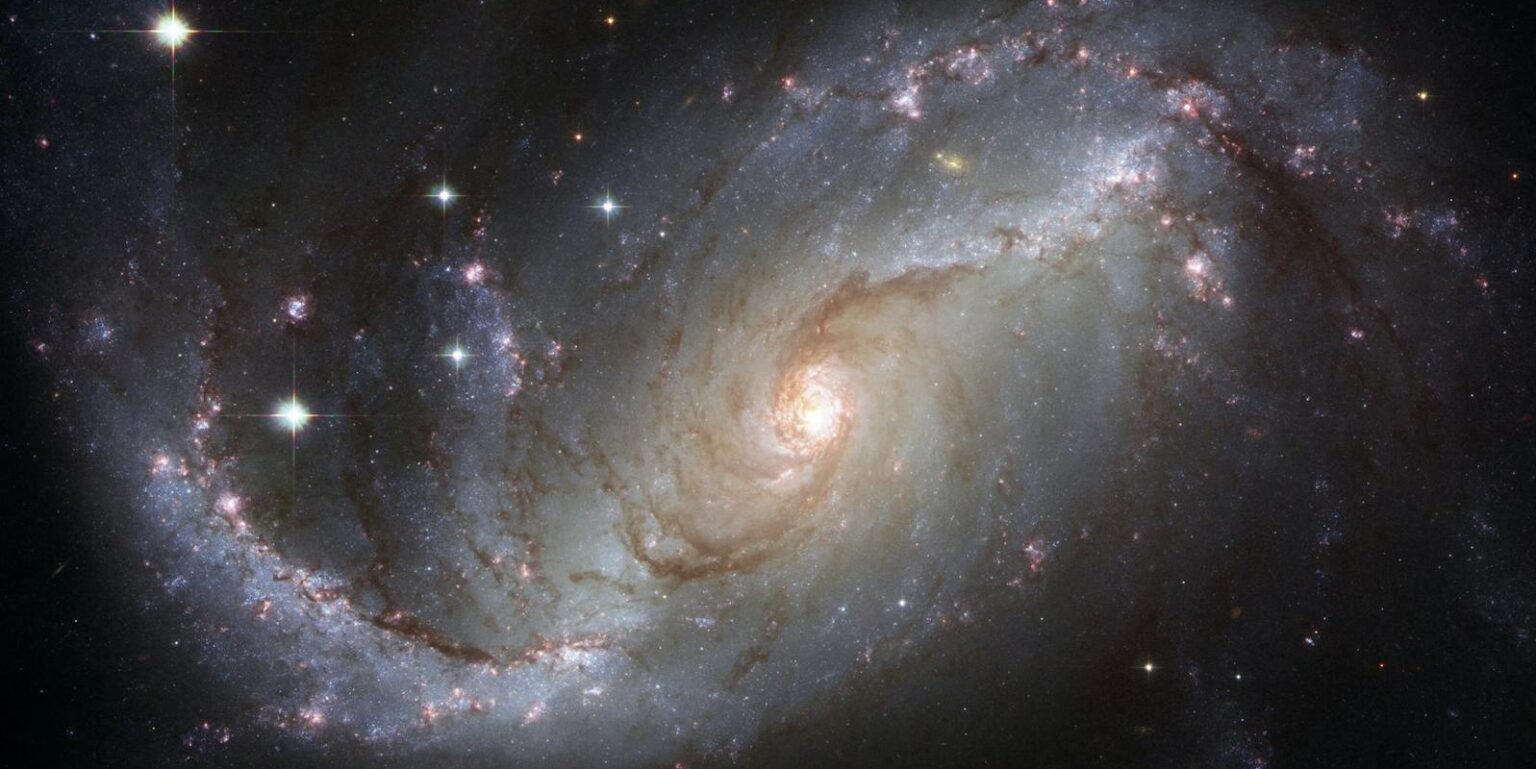
Scientists have achieved a breakthrough in astrophysics by creating the first simulation of the Milky Way capable of tracking more than 100 billion stars individually over a period of 10,000 years. The achievement represents a significant advancement in both computational science and our understanding of galactic evolution.
The research was led by Keiya Hirashima at the RIKEN Centre for Interdisciplinary Theoretical and Mathematical Sciences (iTHEMS) in Japan, in collaboration with the University of Tokyo and Universitat de Barcelona in Spain. By combining deep learning with high-resolution physics, the team was able to overcome long-standing computational barriers that have previously limited galaxy simulations.
For years, scientists have attempted to model galaxies in enough detail to track individual stars and better understand galactic evolution and star formation. However, simulating a galaxy as large as the Milky Way—with its more than 100 billion stars—posed extreme technical challenges.
Also Read: Physicists Prove the Universe Is Not a Computer Simulation
Existing simulations could only handle systems with a mass equivalent to roughly one billion suns. To make calculations manageable, each “particle” in these models typically represented a group of about 100 stars, averaging out the behavior of individual stars. This approach limits the accuracy of modeling small-scale processes, such as the evolution of gas after supernova explosions, which occur rapidly and affect the surrounding stellar and interstellar environments.
The computational difficulty also arises from the time intervals required for simulations. Even with today’s best physics-based models, simulating just one million years of the Milky Way star by star would take about 315 hours. Extrapolated to a billion years, such a simulation would require roughly 36 years of continuous computation. Simply adding more supercomputer cores was not a practical solution, as efficiency declines and energy consumption increase with higher core counts.

Addressing these challenges, Hirashima and his team developed a hybrid approach combining artificial intelligence with physics-based simulations. The deep learning component, or surrogate model, was trained using high-resolution supernova simulations and learned to predict how gas spreads over the 100,000 years following the explosion, allowing the main simulation to proceed without requiring additional computational resources to model these rapid processes.
By integrating this AI component, the researchers were able to maintain both small-scale accuracy and the galaxy’s overall behaviour. The simulation tracks 100 times more stars and operates hundreds of times faster than previous models.
“This achievement shows that AI-accelerated simulations can move beyond pattern recognition to become a genuine tool for scientific discovery,” ANI quoted Hirashima as saying. “It helps us trace how the elements that formed life itself emerged within our galaxy.”
The hybrid AI approach not only enables unprecedented detail in galactic simulations but also holds potential for other large-scale computational challenges. Fields such as climate science, meteorology, and oceanography face similar issues when trying to link small-scale processes with global systems. Techniques like the one developed by Hirashima’s team could accelerate simulations and improve accuracy across these disciplines.
Also Read: AI Successfully Controls Satellite Attitude in Orbit for the First Time
The research team validated their model by comparing results with large-scale runs on RIKEN’s Fugaku supercomputer and the University of Tokyo’s Miyabi Supercomputer System.
Presented at the international supercomputing conference SC ’25, the work marks a major milestone for high-performance computing, AI-assisted modeling, and astrophysics. By combining deep learning and advanced numerical simulations, the team has demonstrated a practical solution to one of the most demanding computational challenges in science, paving the way for future research into galaxy evolution and other complex systems.
The research was published in the Proceedings of the ACM. Read the study here.