



Inside a physics building at the University of Queensland in Australia sits an experiment that has been running for 99 years. There’s no humming machinery or blinking equipment involved, just a glass funnel holding a thick, black substance called pitch, inching its way downward. It moves so slowly that only nine drops have fallen during the entire time the experiment has existed.
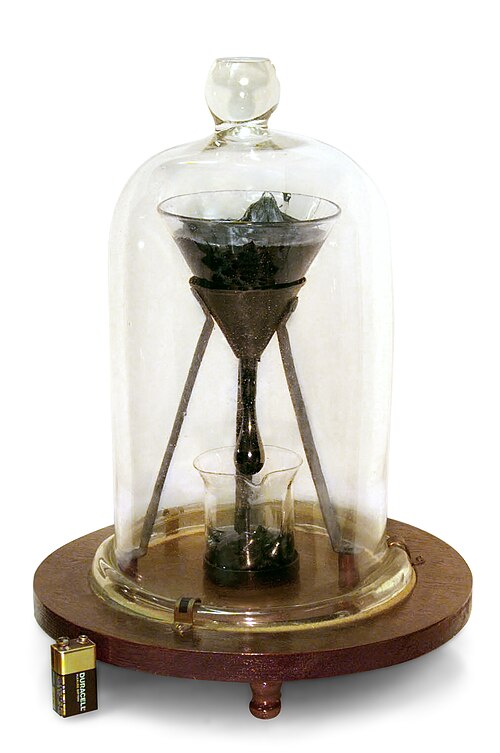
The Pitch Drop Experiment began in 1927, when Thomas Parnell, a physics professor at the university, wanted to show students that some substances which appear completely solid are actually highly viscous fluids. He melted a sample of pitch and poured it into a sealed glass funnel and let it sit for three years before cutting open the funnel’s stem in 1930, allowing the pitch to start moving.
As a material, pitch is a form of bitumen, and at room temperature it looks so solid that you can shatter it with a hammer. But appearances are misleading, since pitch is in fact an extremely viscous fluid, one that flows so slowly no human eye could ever catch it moving. Measurements from the experiment have since put its viscosity at roughly 230 billion times that of water, which is another way of saying it moves slower than continental drift.

"wait, that's real?"
That slowness is exactly why the drops have taken so long to fall. The first one took eight full years to separate, landing in 1938, and for decades after that a new drop arrived roughly every eight years. The pace slowed down even further to 12 to 13 years when the building got air conditioning sometime after the seventh drop fell in 1988.
Also Read: The Invention That Allegedly Cost a Man His Head
This has made the experiment oddly hard to actually witness. When the seventh drop fell during Brisbane’s World Expo 88, nobody saw it happen, because longtime custodian John Mainstone had stepped out for a drink just minutes before it happened. He missed the eighth drop too, in 2000, when a passing thunderstorm cut the power right as the camera should have caught it.
The ninth touched the eighth drop in April 2014, just months after Mainstone passed away, though it remained attached to the funnel at the time. Days later, while the old beaker was being swapped out for a new one, the wooden base wobbled, and the drop finally snapped free.
Mainstone had been custodian since 1961, for a total of 52 years. Yet neither he nor Parnell ever witnessed a drop fall with their own eyes. These days, physicist Andrew White oversees the experiment, waiting for the tenth drop, which is expected to fall sometime between 2020 and 2030.
Also Read: The Hairdresser’s Invention NASA and Boeing Lined Up For
There are more versions of this experiment scattered around the world. One of them, at Trinity College Dublin, has been running since 1944 and had better luck than Queensland’s. In July 2013, physicists there finally captured a drop falling on camera, the first time anyone had recorded the moment in real time.
Guinness World Records officially recognizes the Queensland Pitch Drop Experiment as the longest-running laboratory experiment in the world, and it’s far from over. There’s still enough pitch left in the funnel to keep it dripping for roughly another hundred years, slowly outlasting everyone watching it today, just as it outlasted its founder and generations of curious students, with no guarantee it won’t outlast whoever reads this too.
Story Sources: Wikipedia, The Guardian, The University of Queensland, ScienceAlert, Goodreads, Guinness World Records