

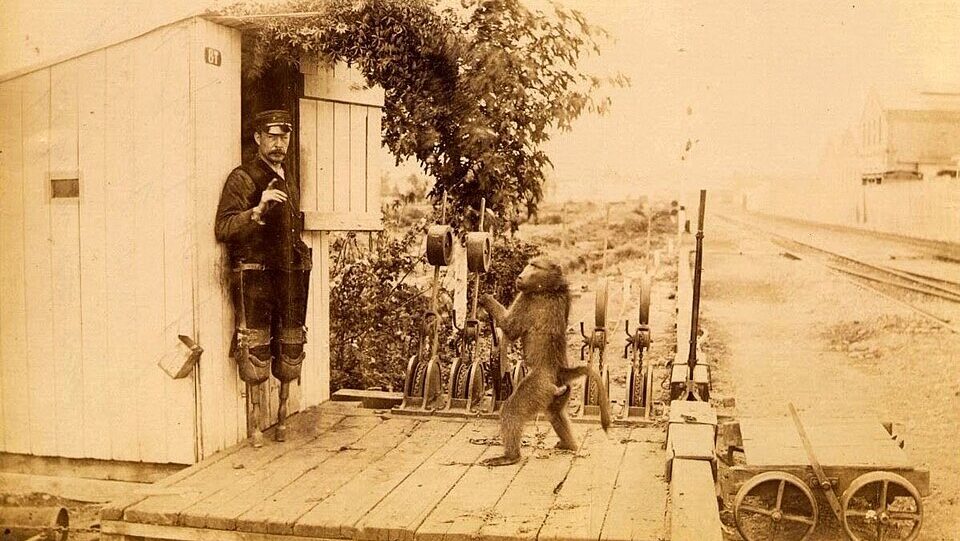
In 1877, a South African railway guard named James Edwin Wide lost both his legs. His coworkers called him “Jumper” for his habit of leaping between moving railcars, until one jump went wrong and the wheels took his legs below the knee. Wide fashioned himself two wooden legs, proved he could still work, and got moved to a signal box job at Uitenhage station near Port Elizabeth, where the railway company appointed him signalman.

"wait, that's real?"
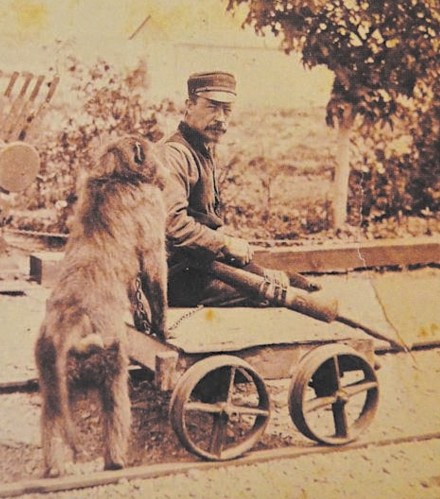
The commute was still brutal on wooden legs. So one day at the market, Wide spotted a chacma baboon leading an oxcart, and impressed by what the animal could clearly do, he bought it, named it Jack, and took it home as an assistant. Jack pushed Wide’s trolley to work, swept floors, and carried the coal shed key across the yard whenever trains needed loading. However, it quickly became clear that Jack was capable of much more.
Wide began training Jack to help him at the signal box. At those times, trains rolling toward Uitenhage would blow their whistle a set number of times to tell the signalman which track to change. By watching Wide switch the levers, and by Wide signaling him with his fingers which lever to pull, Jack picked up the pattern and started pulling on the levers himself.
Also Read: The Strange Mystery of England’s 1855 “Devil Footprints”
Although Wide used to supervise him, he had trained Jack so well that Wide could sit inside doing other tasks while Jack, chained up outside, did the work alone.
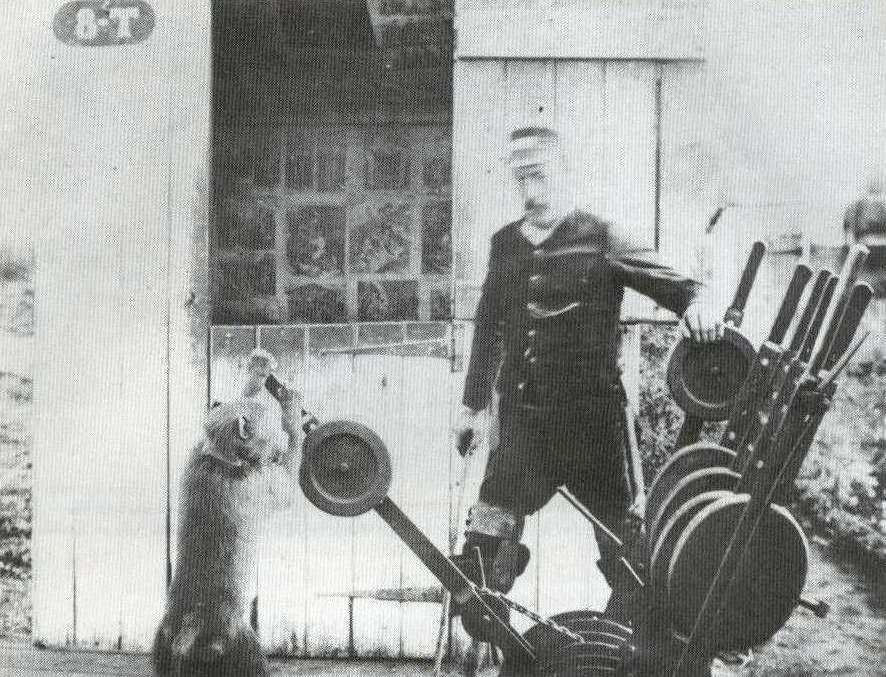
What Jack had learned was to link a specific sound to a specific action and repeat it on his own. That’s associative learning. You’ve probably heard of Pavlov’s dog, where the sound of a bell alone made a dog expect food. Jack’s case was a bit more complex. A bell always led to the same conditioned response. Jack had to tell different whistle patterns apart and match each one to a different lever, so each whistle wasn’t pointing to just one response, it was pointing him to the right choice among several.
And it wasn’t happening in a lab with treats on the line. It was a real railway, where getting it wrong had real consequences.
This is the part where it should have fallen apart. A baboon operating railway signals is exactly the kind of thing that gets a company shut down and a man fired. And it nearly did. A startled passenger looked out her window, saw a baboon running the signals instead of a person, and complained about it. Railway officials arrived, and both Wide and Jack were fired on the spot. Wide pleaded his case, and the officials agreed to test Jack before making the decision final.
"wait, that's real?"
Jack passed. Not sort of passed. He passed clean. The officials were reportedly so impressed that they gave Jack an official employee number. From then on Jack was on the books as a paid railway worker, earning twenty cents a day and half a bottle of beer a week.
A superintendent named George Howe, visiting Wide and Jack around 1890, wrote:
It was very touching to see his fondness for his master. As I drew near they were both sitting on the trolley. The baboon’s arms round his master’s neck, the other stroking Wide’s face. At my approach Jack jumped to the ground, but his strong love could not be restrained.
Jack held the job for nine years. Multiple accounts, including a note published in the journal Nature, describe the same claim. In nine years pulling signal levers at a real train station, Jack never made a single mistake. He died of tuberculosis in 1890. His skull ended up in the collection of South Africa’s Albany Museum, where it still sits today.
Also Read: This WWII Soldier Went to War With a Sword, a Longbow, and Bagpipes
Whether Jack truly understood what he was doing, or was just running a pattern he’d been trained into, a baboon did a real signalman’s job for nine years and never once got it wrong, which says something bigger than just Jack. Our distant relatives, not just primates but also all others, are often more capable than we expect. Intelligence was never really humans on one side and everyone else on the other. It’s a gradient, and we may stand near the top, but the other side isn’t just blank.
And if you made it here, you’re the kind of person who’d like what we send on Sundays — stories like this, every week, straight to your inbox. Join our newsletter.
Story Sources: Wikipedia, Mental Floss, Guide Book to Life, Baboon Matters, Amusing Planet, All That’s Interesting, Today in History, Archive – Knoxville Daily Sun