

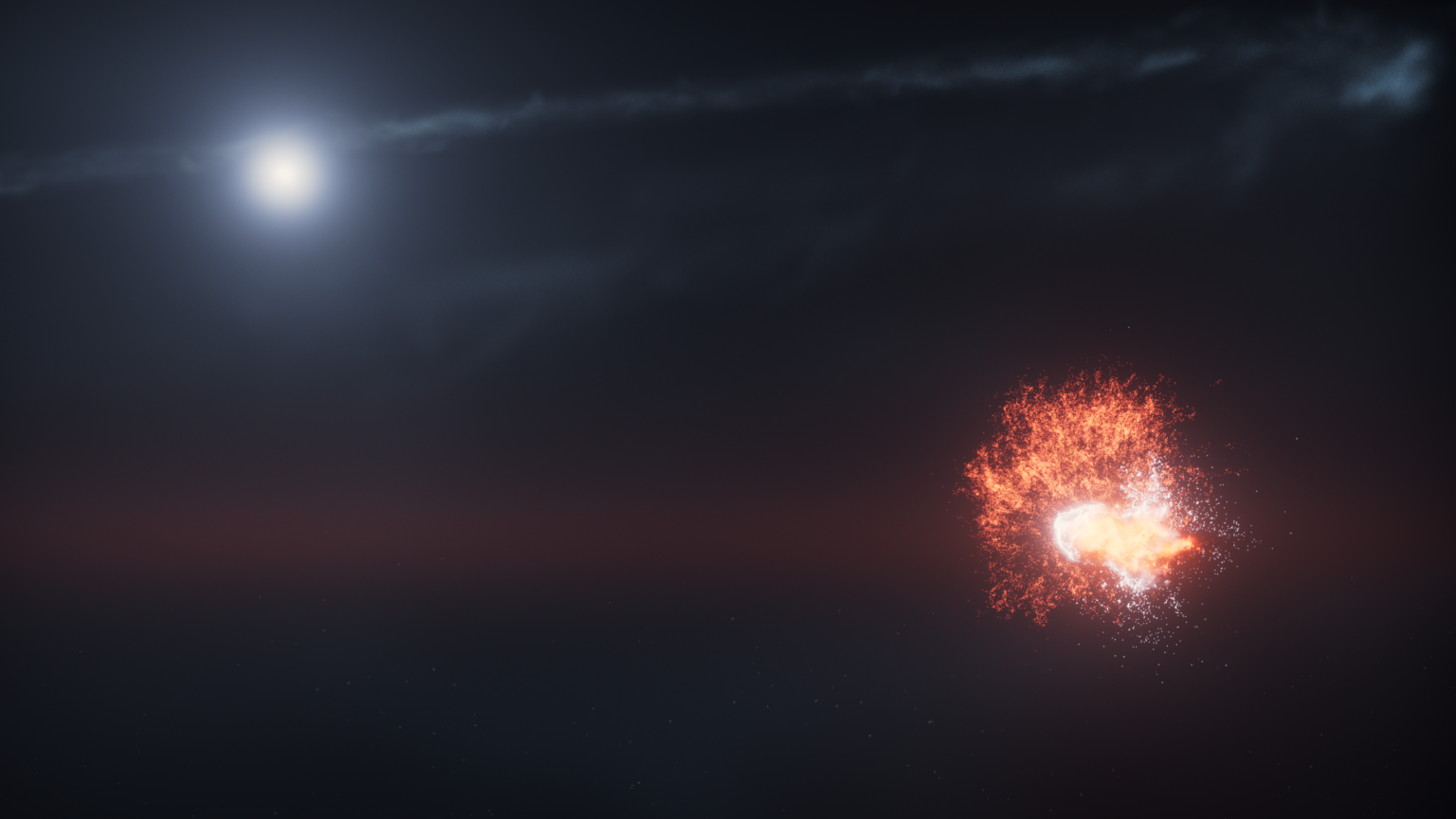
Astronomers studying the nearby Fomalhaut system have confirmed that a long-debated exoplanet candidate was actually a cloud of debris produced by a collision between rocky objects.
New data reveal that two such collisions occurred in the system within just a few decades, producing compact dust clouds that briefly appeared planet-like in telescope images.
The discovery, reported in Science, marks the first time astronomers have directly witnessed the aftermath of planetesimal collisions outside our Solar System.
Also Read: JWST Discovers Alaknanda, a Surprising Twin Galaxy of the Milky Way
Fomalhaut is a triple star system that sits only about 25 light-years away, making it one of our closest neighbours with a prominent debris disk. The star Fomalhaut A is the most massive star among the three. It’s also young, just 400 million years old, and surrounded by a vast belt of dust and rocky material, the leftovers of planet formation. For years, astronomers have kept a close watch on it.
Back in 2008, Hubble images revealed a bright source inside that disk. It was named Fomalhaut b. At the time, scientists assumed it was a dust-covered exoplanet reflecting starlight.
The real surprise came much later.
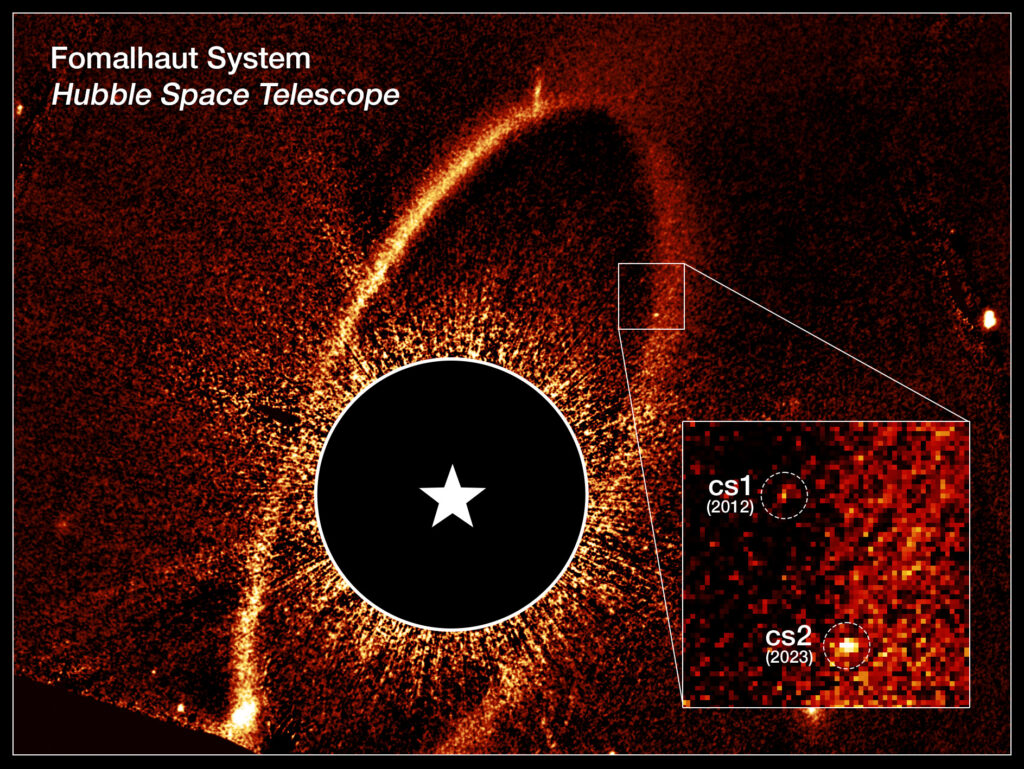
When astronomers pointed Hubble back at the system in 2023, Fomalhaut b was simply gone. In its place, they spotted a new bright source, slightly offset from the original location.
“This is certainly the first time I’ve ever seen a point of light appear out of nowhere in an exoplanetary system,” said lead author Paul Kalas of the University of California, Berkeley. “It wasn’t present in any of our previous Hubble images.”
The original source, named cs1, had slowly faded and spread out over time, a behaviour that matches an expanding cloud of dust rather than a solid planet. The new source, cs2, appears to be another compact dust cloud, freshly created and shining in reflected starlight.
That means the researchers witnessed a violent collision between two massive objects, each tens of kilometres across, releasing vast amounts of dust. That dust briefly forms a compact, bright cloud before gradually dispersing into the surrounding debris disk.
What makes the finding especially striking is how close together the two events appear to be. “Previous theory suggests that there should be one collision every 100,000 years, or longer. Here, in 20 years, we’ve seen two,” Kalas said. “If you had a movie of the last 3,000 years, and it was sped up so that every year was a fraction of a second, imagine how many flashes you’d see over that time. Fomalhaut’s planetary system would be sparkling with these collisions.”
By modelling the dust clouds, the researchers estimate the planetesimals were about 30 kilometres in size. From that, they inferred the disk could contain 300 million similar objects, orbiting in the Fomalhaut system.
In other words, Fomalhaut is not a calm planetary system. It is still very much under construction.
Also Read: AI Creates the First 100-Billion-Star Simulation of the Milky Way
There’s also an important lesson here for exoplanet hunters. “What we learned is that a large dust cloud can masquerade as a planet for a long time,” Kalas said. In this case, cs1 looked like a planet for years when observed in reflected light. “This is a cautionary note for future missions that aim to detect extrasolar planets in reflected light,” Kalas added.
This matters because upcoming telescopes are designed to directly image small, Earth-like planets around nearby stars. Distinguishing real worlds from the dusty aftermath of cosmic crashes will be critical.
The team isn’t done with Fomalhaut yet. They plan to track how cs2 changes over time and will use the James Webb Space Telescope to study the dust in more detail. Webb can reveal the size and composition of the cloud’s dust grains, including whether the cloud contains water and ice.
Instead of revealing a neat picture of a distant planet, Fomalhaut has offered something messier and more revealing: a rare glimpse of planetary systems in action, where worlds are not just forming, but sometimes violently falling apart.
The study is published in Science.